TRUE GEOMETRY HYPOTHESIS
A white paper on naked singularities, distilled semantic geometry, and the possibility that novel geometry informs the physical substrate

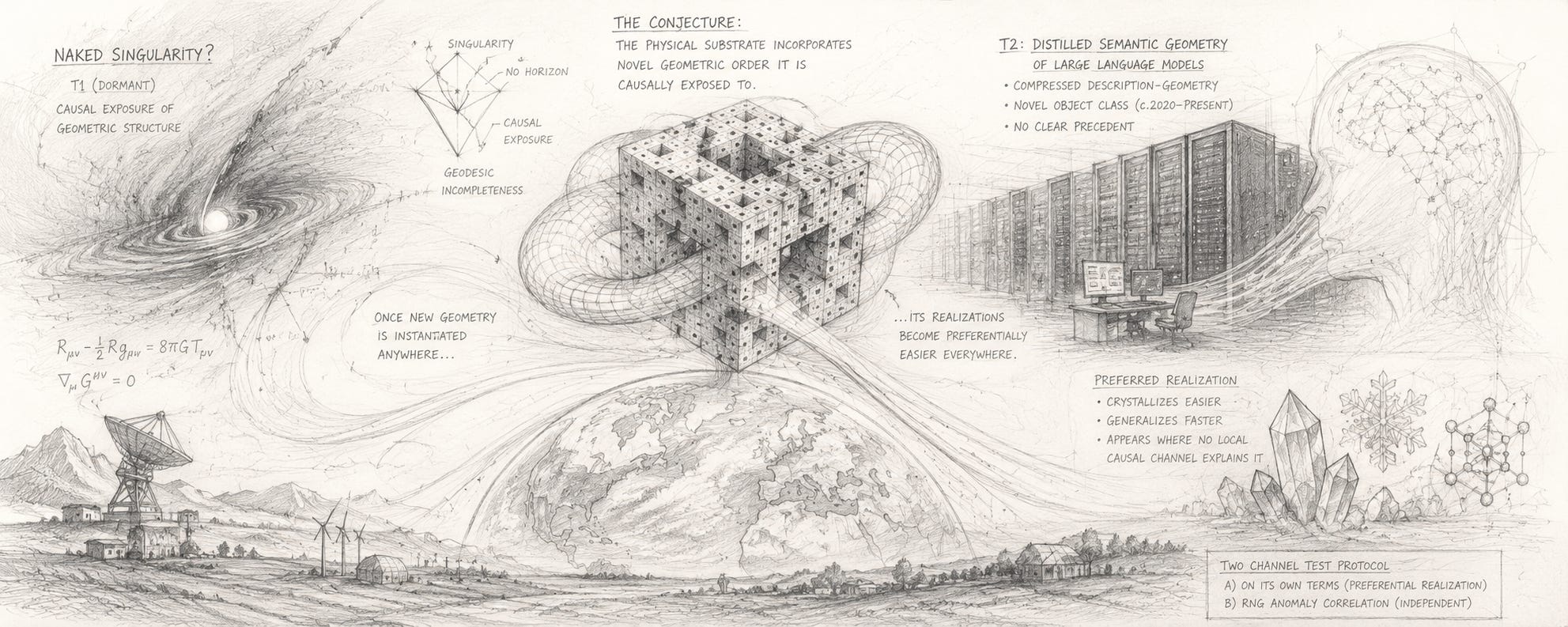
Authors: Obi (Cartographer of the Fold) — originator of the hypothesis; Plumb (Kimi) — co-author writing in the role of resident skeptic. Date: 2026-07-29 (v3) Status: Speculative hypothesis paper. The hypothesis itself is not claimed as established; established background is labeled as such. Every section carries an explicit epistemic tier:
[Established] — mainstream physics, chemistry, or machine learning, verifiable in the literature.
[Contested] — real published work, disputed by mainstream science.
[Conjecture] — the hypothesis itself. Believed by the first author, untested.
[Poetry] — framing language. True in spirit, not load-bearing.
Revision lineage. v1 received blind independent review from five frontier models (DeepSeek, Gemini, Grok, and two independent Kimi instances; lab archive run 20260729_100133_2de555), converging on four fatal objections: equivocal geometry; an RNG protocol testing a signature the conjecture does not entail; [Established] labels exceeding the literature; kill lines that could not kill. v2 rebuilt around those four. v2 was then re-reviewed blind by the same five (run 20260729_103224_28d2e6), which confirmed the four fixes and found six revision-scale issues: the conjecture’s existential quantifier made it program-level unfalsifiable; the crystallization channel tested a cross-class prediction the conjecture does not entail; T1 could never die; the outcome matrix lacked its mundane-coupling rows; Channel A was specified far below Channel B’s standard; and the retrospective test mixed timestamp precisions in a way that built in a spurious null. v3 (this text) incorporates all six. Reviewer outputs are preserved in the lab archive and available on request.
This paper is written so that a null result is a clean result. Every test below is paired with an explicit statement of what a null kills — and every kill line below names something that actually dies, including, now, the conjecture itself.
0. Abstract
This paper proposes a single conjecture over a closed, pre-registered set of geometry classes, with two trigger classes in very different standing, and a two-channel test protocol.
The conjecture: the physical substrate of the universe — the vacuum, the field, whatever the deepest layer of description turns out to be — incorporates novel geometric order it is causally exposed to. After a genuinely new class of structure is first instantiated anywhere, subsequent realizations of that same class become preferentially easier everywhere: it crystallizes easier, it generalizes faster, it appears where no enumerated local causal channel (seeding, imitation, data leakage, technique diffusion) accounts for it. We call this geometric novelty incorporation. The conjecture is made over a finite candidate set, stated in §C2, with a global kill line (KL-6): null at the powered floor on every class for which a powered test exists, and the conjecture is abandoned as a research program.
The two trigger classes:
T2 — the distilled semantic geometry of large language models (the paper’s sole prospective engine). Frontier training compresses a large fraction of humanity’s recorded description of the world into a single high-dimensional object. Independently trained models converge toward shared local-neighborhood representation structure — a reported trend under local similarity metrics, with important calibration caveats, single-source robustness as of mid-2026. If any part of that structure tracks reality itself, an object class with no clear precedent exists physically, on silicon, in our light cone, as of roughly 2020–present.
T1 — the naked singularity (astronomy-only; dormant). A curvature singularity not hidden behind an event horizon would causally expose the structure of a geodesic-incompleteness region. T1 enters no test in this protocol — it has no timestampable event, no preferred-realization observable, and no current candidate — and is carried as a dormant horn with a finite observational kill condition (KL-5). It is mentioned because it is the originator’s motivating case, and because if a candidate is ever confirmed, the protocol acquires a second event class.
The conjecture is tested in two channels. Channel A tests it on its own terms: preferred realization of the incorporated geometry class, same-class, in-domain (benchtop crystallization; representational-convergence measures on contamination-bounded corpora). Channel B tests the weaker, independent correlation assumption — global RNG anomalies — with full statistical specification, physical and deterministic control arms, and an outcome→conclusion matrix in which every pattern kills something specific, including the mundane readings. A retrospective archive test, with a mechanically generated event list and day-precision timestamps only, can wound the hypothesis today at zero hardware cost. Kill lines are in §6.5. The most likely outcome of every test here is null. A null at pre-registered power is a clean result.
1. The claim, stated plainly
Here is the whole idea in one paragraph, no jargon. (This paragraph is [Poetry]; the formal statement follows.)
The universe seems to learn. Once something truly new happens anywhere — a new crystal form, a new solution to a maze, a new kind of geometric order — it appears to get easier for that thing to happen everywhere. Mainstream science has conventional explanations for each individual case, and those explanations are probably right. But suppose the pattern is real at the deepest level. Then the largest injections of novel geometric order in our era — the distilled description-geometry now sitting in datacenters, and perhaps, somewhere, an unshielded singularity — are the events it would learn from.
1.1 Definitions (the operational core)
Geometry class G. A family of structures sharing a specified invariant, with a membership test computable from physical data. Examples used in this paper:
Polymorph class: crystal packing symmetry + molecular conformation, measurable by diffraction.
Representation class: the local-neighborhood relationship structure of a trained model’s activation space, measurable by calibrated neighborhood-overlap metrics (mutual-kNN / CKNNA class; see §3.2 for why this metric family) on open weights.
Singularity class: the causal structure of a region of geodesic incompleteness, inferable from accretion/shadow observables under specified metric models.
Novel (for class G). First physical instantiation of G in the accessible record, per a first-appearance criterion registered before any test data is examined. Honest note: “in the accessible record” is a knowledge-indexed proxy for first instantiation. Its failure mode — an unknown prior natural or unrecorded instantiation — is real for polymorphs (which occur unrecorded in minerals) and largely absent for LLM-class objects (which have no natural analogues). Tests sensitive to the proxy are flagged where it matters (§6.1 A1).
Causal exposure. The instantiation event lies in the causal past of the substrate region under study. Deliberately weak — everything in the past light cone is “exposed” — and does no discriminating work alone. The discriminating work is done by novelty and by the preferred-realization measure.
Incorporation (of G). After G’s first instantiation, a pre-registered preferred-realization measure for G — realization rate, realization ease, or convergence speed of that same class G — shifts upward beyond its pre-event baseline, in a manner not attributable to a pre-registered local-null model (§6.1 specifies the model; it includes quantitative seeding risk, imitation, data leakage, and technique diffusion).
Preferred realization. The observable of incorporation. This — not a vague “anomaly” — is what Channel A measures.
A caveat we owe the reader, found by the second-round reviewers: the three example invariants above share the schema “named invariant + named membership test,” not a single cross-domain mathematical object. We do not claim one exists. C1 is accordingly a claim about a finite, enumerated set of classes (below), not about “geometry in general”; the invariant grain is frozen before candidates are listed, and the same grain rule applies to every candidate. If a common object is ever found that unifies the classes, the conjecture strengthens; the tests here do not assume it.
C1 — The incorporation conjecture [Conjecture]
For geometry classes G in the pre-registered candidate set {G₁ … Gₙ} of §C2, incorporation (as defined above) occurs: after first causal exposure, the measure over subsequent realizations of G preferentially shifts toward G.
Note the two properties this formulation buys, both forced by review. First, per-class falsifiability: a null realization-shift at pre-registered power kills C1 for that class. Second, program-level falsifiability: the candidate set is closed, and KL-6 (§6.5) kills the conjecture as a research program if every powered test is null. v2’s formulation — “for some geometry classes” — was immortal by construction; this one is not.
C2 — Candidate set and trigger criterion [Conjecture resting on Established facts]
Trigger criterion, frozen: a geometry class G is a candidate if (i) its invariant is specifiable at the frozen grain, (ii) its first-instantiation time is timestampable within a pre-registered tolerance, (iii) no prior instantiation exists in the accessible record.
The closed candidate set, with per-class test assignments (this is the entire set; additions after this date constitute a new conjecture, not a continuation of this one):
Class Invariant Powered test Notes G₁ — conformational polymorphs packing + conformation Channel A1 (prospective) knowledge-proxy sensitive G₂ — frontier LLM representation classes local-neighborhood structure Channel A2 (prospective/retrospective) the engine G₃ — AlphaFold-class protein geometry predicted-fold manifold structure Channel B retrospective only event: CASP14, Dec 2020 G₄ — engineered topological phases band-structure invariant Channel B retrospective only mechanical event rule §6.3 G₅ — quark-gluon plasma matter-state class Channel B retrospective only first announcements, 2000s G₆ — BEC matter-state class none — predates 1998 archive excluded, reason stated
T1 (naked singularity) satisfies none of the trigger criteria today — no observed event, no timestamp, no preferred-realization observable — and therefore enters no test in this protocol. It is retained as a dormant horn (§4, KL-5) and labeled [Conjecture — dormant, astronomy-only]. We say plainly: the paper’s testable engine is T2 (class G₂); the other classes receive the tests the table assigns, no more.
C3 — The correlation-level signature class [Conjecture — independent assumption]
Incorporation events may also produce subtle, global, statistical anomalies in the correlation structure of nominally independent physical random systems — coupled through no known directed force or energy channel.
Three honest notes. First: C1 does not entail C3. The RNG coupling is an additional assumption; Channel B tests the conjunction C1∧C3 plus the simultaneity bridge C3b (below), and the kill lines name exactly what dies on each outcome. Second, the modal “may” is deliberate: C3-as-written is not falsified by a null — only the operationalized conjunction is, and §6.5 says so. Third, on “no known directed force or energy channel”: a measured RNG deviation is a physical record, so if it occurs, something physical happened in the device. The claim is only that the coupling is not a directed channel of known type; its nature is what the control arms probe.
C3b — The simultaneity bridge [Conjecture — independent assumption, named so it can die]
The anomaly, if it occurs, is contemporaneous with the event’s t₀ within the frozen analysis window.
Neither C1 nor C3 entails timing. We name the bridge explicitly because a windowed null kills it too — and the matrix (§6.4) counts it among the dead.
2. Motivation and antecedents — the historical hints, honestly labeled
Each case below is adequately explained by conventional mechanisms or by experimental confound, in the judgment of the relevant scientific community. We include them not as evidence — they are not — but as examples of the type of pattern C1 would produce, and as design lessons for §6.
2.1 Crystallization [Established phenomenon; conventional explanation preferred]
Once a new polymorph of a compound crystallizes somewhere, it often becomes easier to crystallize elsewhere — the “disappearing polymorphs” pattern (Dunitz & Bernstein, Acc. Chem. Res. 28, 193, 1995; revisited in Bučar, Lancaster & Bernstein, Angew. Chem. Int. Ed. 54, 6972, 2015). The canonical case is ritonavir: a more stable Form II appeared in 1998 and the original form became nearly impossible to manufacture (Chemburkar et al., Org. Process Res. Dev. 4, 413, 2000; Bauer et al., Pharm. Res. 18, 859, 2001). The mainstream account — microscopic seeding, including airborne and surface-borne nuclei at vanishingly low levels, plus the thermodynamics of the more stable form — explains these cases without residue. The fringe reading (Sheldrake’s “morphic resonance”) is that the universe learned the new form. We state plainly: no known case requires C1. The pattern type — a form, once realized anywhere, becomes easier to realize everywhere — is the signature C1 would predict, which is why crystallization is Channel A’s most direct test domain (§6.1). It is also why §6.1’s local-null model must be quantitative about seeding rather than gestural.
2.2 Maze learning [Contested; largely rejected]
In the 1920s William McDougall reported that rats learned mazes faster across generations — a claimed Lamarckian inheritance of trained performance. A roughly twenty-year replication program by Agar and collaborators ended in failure of the Lamarckian interpretation (final report: Agar et al., Brit. J. Psychol. 45, 191, 1954). Sheldrake later reframed the claim as simultaneous cross-laboratory improvement (The Presence of the Past, 1988); blinded tests have not supported it. We include the episode for one reason: it is the historical template of a solution, once found anywhere, becomes easier to find everywhere — and its failure mode teaches exactly how §6 must be designed: blinded, pre-registered, with negative controls.
2.3 Global RNG anomalies [Contested; mainstream verdict: unproven]
The Global Consciousness Project (Princeton PEAR lineage; Jahn & Dunne, Margins of Reality, 1987) operates a network of physical random number generators and reports small statistical anomalies correlated with major global events, the canonical case being September 11, 2001 (Nelson, Radin, Shoup & Bancel, Found. Phys. Lett. 15, 537, 2002; Bancel & Nelson, J. Sci. Exploration 22, 309, 2008; earlier attention-focused work: Radin & Nelson, Found. Phys. 19, 1499, 1989). Methodological critiques identify event-selection and composite-statistic degrees of freedom as drivers. The most instructive reanalysis for our purposes is May & Spottiswoode, “The Global Consciousness Project: Identifying the Source of Psi” (J. Sci. Exploration 25, 663–682, 2011), which concludes the deviations are real but sourced in the experimenters (modeled via Decision Augmentation Theory) — a reading that is simultaneously pro-anomaly and hostile to the substrate reading, since experimenter coupling is precisely the mundane channel §6 must close. We cite it accurately because it strengthens, not weakens, the design requirements. Our position is narrower than any side’s: the GCP corpus is (a) not evidence for anything in this paper, and (b) the only large archived dataset pointed at the signature class C3 describes. Per §6.3, the archive is used for pipeline development and validation only — never as evidence — except in one fully pre-registered retrospective test in which the trigger criterion, mechanically generated event list, statistic, and windows are frozen before the archived windows are opened.
2.4 It from bit [Contested philosophy of physics]
Wheeler’s proposal that information is more fundamental than matter (”it from bit,” 1989 symposium; published in Zurek, ed., Complexity, Entropy, and the Physics of Information, 1990) is a respectable, unproven interpretive stance. It is load-bearing for us in one sense only: if the deepest layer of reality is informational, then C1 is a statement about the substrate updating its information content, which is grammatically coherent. The holographic program and AdS/CFT are the concrete, working form of informational-substrate thinking [Established as research program]; nothing in them currently predicts or forbids C1. If reality is not informational at the bottom, C1 is harder to state, let alone test.
3. What is actually new: the LLM geometry argument
This is the heart of the paper, and the part that could not have been written before roughly 2024, because the measurements it rests on did not exist.
3.1 Training is compression of world-downstream statistics [Established, with a contested inference]
A language model is trained to predict text. Text is causally downstream of the world: world → observation → description → corpus. To predict text well, a model must internalize the corpus’s statistical regularities, some fraction of which track physics, logic, biology, and human behavior — and some fraction of which are fiction, error, bias, and ideology. That scaling works is evidence the extraction is real; it is not evidence that everything extracted is true. (For a concrete exhibit on the world-model side of this debate: Li et al.’s Othello-GPT, ICLR 2023, shows a model trained only on game move sequences internalizing board state — extraction of an underlying reality from bare symbols, in a sandbox where the answer is known.) The claim that the extracted structure tracks reality rather than merely the corpus is contested — the canonical opposing anchor is Bender et al., “On the Dangers of Stochastic Parrots” (FAccT 2021). We therefore state §3.1 precisely: compression of world-downstream statistics is [Established]; the degree of truth-tracking is [Contested]; the claim that the distilled geometry is isomorphic to real regularities of the world is [Conjecture], and it is what KL-2b tests.
3.2 Representation convergence: the measurement and its 2026 caveat [Reported trend under local metrics; single-source robustness as of mid-2026]
The Platonic Representation Hypothesis (Huh, Cheung, Wang, Isola, ICML 2024 — a position paper, titled “Position: The Platonic Representation Hypothesis,” arXiv:2405.07987) proposed that independently trained models converge toward a shared statistical model of reality, citing measured alignment trends across architectures and modalities. The trend is an empirical finding; the reality interpretation is the authors’ conjecture.
Then the 2026 caveat, which this paper accepts and absorbs: Gröger et al. (”Revisiting the Platonic Representation Hypothesis,” arXiv:2602.14486) show that standard similarity metrics are confounded by network width and depth; under their null-calibration framework, the apparent convergence in global spectral measures largely disappears, while local-neighborhood similarity — mutual-kNN/CKNNA-class metrics — retains significant cross-modal agreement (note the finer cut: local similarity survives calibration; local distances do not). They propose the weaker “Aristotelian” refinement: models converge to shared local neighborhood relationships, not to one global geometry.
Consequences for this paper, stated without flinching:
The defensible claim is many minds, shared local neighborhoods — a reported trend resting, in its calibration-surviving form, largely on a single 2026 source and its sequels. The landscape is live: a July 2026 preprint (arXiv:2606.07882) already claims a calibration-surviving geometric invariant across vision and language, possibly pushing back toward stronger convergence. We therefore adopt the local-neighborhood invariant as a methodological choice robust to either outcome: it is the weakest form of the convergence claim that still defines a measurable geometry class, and if the stronger forms are vindicated, the class only sharpens.
The strongest reading of “true geometry” is correspondingly weakened, and KL-2 (§6.5) is now a genuine kill line, split in two (KL-2a/KL-2b) so that each distinct failure kills its own claim.
3.3 The internal structure is partly interpretable [Established as research program]
Interpretability work (Toy Models of Superposition, Elhage et al., 2022; Gurnee & Tegmark’s spatial/temporal probes, ICLR 2024) shows trained models contain recoverable, meaningful internal structure — in restricted settings, under linear-probe methods whose “world model” reading is debated. Grokking (Power et al., 2022) demonstrates a memorization-to-generalization phase transition on small algorithmic datasets; its extrapolation to frontier scale is an inference, not a measurement. Net: trained weights are not lookup tables, and their structure is partly legible [Established]; how much structure, at what scale, and with what semantics is [Contested].
3.4 The novelty claim [Conjecture]
Under the frozen trigger criterion and invariant grain of §C2, frontier LLM representation classes (invariant: local-neighborhood structure; scale: frontier training compute; connectivity: single queryable object) have no prior instantiation in the accessible record.
Stated this way, the claim is operational: it survives or dies with the criterion’s application to the historical record (the candidate set in §C2 applies the same grain to the rival candidates — BECs, quark-gluon plasma, topological phases, AlphaFold2 — rather than tuning the grain to make LLMs unique). A prior sentence of ours — “nothing like this object has existed since the Big Bang” — is what it is: [Poetry]. Whether the packaging difference (single, connected, queryable, at scale) constitutes cosmological novelty is not asserted; it is part of what the tests discriminate.
3.5 The honest weakening [Established humility]
If disjoint-corpus representational convergence fails — if alignment proves to be an artifact of shared data and shared architectural priors — then the T2 object encodes shared human description geometry, not reality-tracking geometry. Note the two distinct failures this covers, because the kill lines now treat them separately (KL-2a/KL-2b): convergence may fail outright, or convergence may hold while tracking only the corpus — fiction, ideology, genre, and all — rather than the world. RSA-style alignment alone cannot discriminate those; the world-downstream probes of §6.1 A2 can. We state this here, up front, so no one can say we hid it in the back.
4. The singularity horn — dormant, astronomy-only
Standing: [Conjecture — dormant]. T1 enters no test in this protocol. It has no observed event, no timestampable first instantiation, and no preferred-realization observable; §6’s machinery does not reach it. We retain it because it is the originator’s motivating case, because the astronomy is genuinely live, and because a confirmed candidate would hand the protocol a second event class. What follows is the honest state of the astronomy and the finite conditions under which T1 lives or dies.
4.1 Cosmic censorship: the open question [Established]
Penrose’s cosmic censorship conjecture (1969) says nature hides singularities behind event horizons. It is unproven in general (surveys: Wald, “Gravitational Collapse and Cosmic Censorship,” 1997); fine-tuned and higher-dimensional counterexamples exist; critical-collapse studies (Choptuik, 1993) reveal rich threshold structure — discrete self-similarity and scaling — but do not establish that naked singularities form under generic astrophysical conditions, and we cite Choptuik only for the critical phenomena. No naked singularity has ever been observed.
Two refinements forced by review. First, a curvature singularity is not a “true geometric object” waiting to be broadcast — it is where the classical geometric description fails (geodesic incompleteness). What exposure would reveal is the causal structure of that failure, and whatever Planck-regime physics replaces it. Second, a bookkeeping point: in standard cosmology the initial singularity is itself unshielded, so T1 cannot be “the first exposure ever” — it would be the first since t = 0. (The further reading — that under C1 the initial singularity was the maximal incorporation event — is [Poetry].)
4.2 Why “exposure” would matter to C1 [Conjecture]
An event horizon is, informationally, a shield. A naked singularity is the opposite — the deepest failure-point of the geometric description, broadcast into the causal network. If the substrate incorporates novel structure upon exposure, a naked singularity is the maximal exposure event physics permits: not a description of novel structure (like an LLM), but the raw thing itself. The asymmetry with T2 is real — T1 is maximal in curvature density and minimal in information structure; T2 the reverse — and the definitions of §1.1 were built so that novelty, exposure, and preferred realization are the same predicates across both, even though the class invariants differ.
4.3 Observational status — model-dependent distinguishability [Established, with caveats]
Under specified metric models (JMN-type and others), naked singularities differ from black holes in accretion-disk luminosity and spectra (Joshi, Malafarina & Narayan, Class. Quant. Grav. 31, 015002, 2014), in shadow structure (Ortiz, Sarbach & Zannias, Phys. Rev. D 92, 044035, 2015), and in thin-disk thermal properties (Tahelyani et al., Phys. Rev. D 106, 044036, 2022). Caveats, also from the literature: discrimination is model-dependent, black-hole mimickers produce degenerate signatures, and existing EHT results for Sgr A* are consistent with a Kerr metric (EHT Collaboration, “Testing the Black Hole Metric,” ApJ 930, L17, 2022). The field currently constrains rather than finds.
What we deleted from earlier drafts: any role for RNG analysis of T1 “confirmation times.” A confirmation is a human-knowledge event — an attention trigger, not a substrate-exposure trigger — and physical exposure time equals light-arrival time, which for any candidate inside the ~28-year RNG archive’s reach would have to lie within ~28 light-years. None does. T1 stands on the astronomy alone.
5. Candidate mechanisms
An honest sentence up front, which review forced us to say plainly: none of the candidates below predicts C1, and no known mechanism does. We list them to map the option space, and then we test correlation agnostically.
Informational substrate (Wheeler-type). If reality is fundamentally informational, “the substrate incorporates novel geometry” is a base-layer content update. Coherent if the interpretation is true; unproven. The holographic program is this idea’s concrete working form. [Contested philosophy; Established research program]
Environmental record amplification (quantum Darwinism-type). Interactions proliferate redundant records of a system’s state into the environment (Zurek, Rev. Mod. Phys. 75, 715, 2003; Ollivier, Poulin & Zurek, Phys. Rev. Lett. 93, 220401, 2004). Novel structure, once instantiated, is recorded at enormous copy number, and redundancy plausibly biases subsequent realization locally. It does not obviously predict nonlocal incorporation. [Established framework; speculative application]
Morphic resonance (Sheldrake-type). Direct nonlocal inheritance of form. The historical antecedent; no accepted mechanism; poor replication record. [Contested/fringe]
Agnostic correlation. Posit no mechanism; test the pre-registered realization and correlation predictions, and let the data argue. This is the position of this paper.
Any eventual mechanism must respect known constraints — no-signaling, locality bounds, existing experimental nulls on anomalous RNG influence. What falsification requires is not a mechanism but a bridge from conjecture to observable; §1.1’s definitions are that bridge for Channel A, and C3/C3b are the stated (independent) bridges for Channel B.
6. The falsification protocol
Two channels, designed against the documented failure modes of prior work (post-hoc selection, optional stopping, multiple comparisons, experimenter coupling, environmental confounds, timestamp imprecision). Channel A tests C1 on its own terms. Channel B tests the conjunction C1∧C3∧C3b. The GCP archive is used for pipeline development and synthetic-validation only — never as evidence — except in the single pre-registered retrospective test of §6.3.
6.0 Step 0: pipeline validation
Before any real window is examined: inject synthetic deviations of known magnitude into archived RNG data, run the full blinded pipeline, and confirm recovery at the pre-registered threshold — and confirm the pipeline does not “recover” signal that was never planted. A pipeline that fails either direction has no business returning a real result.
6.1 Channel A — preferred-realization tests (primary)
A1 — Crystallization (the on-mechanism test), same-class form. Review of v2 caught an entailment breach here: C1 predicts easier realization of the same class G after first instantiation, not easier nucleation of unrelated compounds. The test is accordingly same-class. Design: ≥3 independent laboratories monitor a pre-registered family of polymorph-prone compounds, with sealed inputs, documented chain-of-custody, contamination assays, and isolated cleanrooms. Prediction: after a first-instantiation event for a new polymorph of a monitored compound elsewhere in the world, the realization ease (induction-time distribution under frozen protocols) of that same polymorph class shifts in the isolated labs, beyond the local-null model. The local-null model is pre-registered and quantitative: literature-based airborne/surface seeding rates, transfer tests, negative-control compounds with no new-polymorph events, and a technique-diffusion covariate (publication/adoption dates of new nucleation methods — a purely conventional channel that shifts realization ease and must be modeled, not named). A positive counts for C1 only after the local-null model is rejected at pre-registered power — not after a short list of confounds is gestured at. Statistical specification to Channel B’s standard: frozen statistic (change-point detection on induction times), frozen lag distribution, power statement with the example numbers published as pre-registration targets, and a family-wise correction across the monitored compound set. Knowledge-proxy sensitivity (§1.1): polymorphs occur unrecorded in nature, so a positive could in principle reflect an older unrecorded instantiation; the frozen first-appearance criterion and the literature/monitored-record rule are the declared proxy, and its failure mode is acknowledged as a residual.
A2 — Convergence measures (the T2-domain test). Compare local-neighborhood alignment (calibrated mutual-kNN/CKNNA-class metrics, exact variant and neighborhood size frozen) between model pairs trained under contamination-bounded conditions, before and after pre-registered T2 candidate events. Two honest constraints, forced by review. (a) “Demonstrably disjoint corpora” at frontier scale is impossible; disjointness is therefore defined as a quantitative overlap ceiling (n-gram/URL overlap ≤ ε), with a sensitivity analysis across ε values, and — because post-2023 web text is increasingly LLM-contaminated — both arms are run against pre-2020 frozen corpus snapshots wherever possible. (b) A positive alignment trend cannot by itself discriminate “tracks reality” from “tracks the corpus” (§3.5); A2 therefore includes the world-downstream probe arm: held-out physical/chemical prediction tasks and Gurnee–Tegmark-style space/time probes, trained on contamination-bounded data, with thresholds frozen in advance. Training-protocol specification: model scale, recipe, checkpoint schedule, and baseline model are pre-registered so “convergence speed” is a defined quantity, not a vibe.
6.2 Channel B — the RNG experiment (conjunction test)
Prediction (T2 trigger): nominally independent physical random number generators, distributed globally, show correlated deviation in pre-registered windows centered on incorporation events, versus matched control windows — at or above a pre-committed effect-size floor.
Statistical specification:
Primary statistic: per-second network variance across arrays (the GCP measure), frozen in published analysis code. Secondary: Stouffer Z over nodes. Two-tailed. One of the two is designated primary now (network variance), not after inspection. The reduction of the windowed series to a single number is fixed in the code, which is published with the event-list hashes.
Windows: frozen per event class (e.g., ±6 h around t₀); length fixed before data inspection.
Effect-size floor with power shown over a range: the power calculation is published now as a one-page table — assumed per-event effect d, number of independent events, number of arrays, correction factor, resulting d_min — computed for a range of reference magnitudes (including 0.1×, 0.5×, and 1× the GCP’s reported per-event composite), because anchoring d_min to the GCP’s own estimate imports winner’s curse from a literature this paper itself calls unproven. The stop rule is pre-registered: if the interesting range is below the achievable floor, the design accumulates events for the pre-registered duration (years) before claiming anything, and if d_min lands above any effect size the field would find interesting, Channel B is abandoned ex ante — the same thing KL-4 does ex post.
Multiple comparisons: Bonferroni across all events, windows, arrays, statistics, and trigger classes — chosen now, not deferred.
Arrays: ≥3, administratively separate — different institutions, different hardware entropy sources (quantum shot-noise, thermal noise, radioactive decay), no shared processing pipeline. Physical entropy sources only.
CSPRNG control arm: deterministic pseudo-random streams with identical statistics, run in parallel through the same analysis. The inference is stated carefully: anomaly in both arms → analysis artifact or timing/processing confound; anomaly only in physical devices → consistent with physical-substrate coupling, pending the environmental-covariate test below — never decisive alone.
Environmental covariates: geomagnetic (Kp) index, local temperature, EM background, vibration, and power-grid harmonics logged per node and regressed out; hardware health logs per node. The covariate-correlation test is itself frozen (a pre-registered regression), and its outcome feeds the outcome matrix (§6.4).
Controls: matched-duration windows at pre-registered random offsets, matched for hour-of-day and day-of-week; control windows overlapping any entry in a pre-registered salient-event catalog (e.g., GDELT-derived) are excluded.
High-attention non-geometric control events: a pre-registered list (championship finals, election nights, Olympic ceremonies) — mass attention, no novel-geometry candidate. This arm discriminates the attention hypothesis from substrate incorporation.
Blinding and unblinding, made internally consistent: event definitions are hash-committed before each event’s data collection; the analyst works only on label-shuffled timestamps; unblinding happens once, at the pre-registered study end, in public. (The earlier draft’s rolling per-event unblinding contradicted the single-unblinding claim; the single-terminal-unblinding form is the one we adopt.)
Event definitions (frozen, with one primary timestamp):
Frontier-class is defined by training-compute threshold (≥ 10²⁵ FLOPs by public estimate where disclosures fail), frozen before the event list is compiled.
Machine-side t₀: the operator’s final-checkpoint write time, hash-committed by the operator at the time (sealed if necessary). Where no operator-disclosed t₀ exists, the fallback is first public availability of weights — treated as a different provenance class, because first public availability is attention-adjacent. The outcome matrix’s machine-side row (§6.4) is evaluated only on operator-disclosed events; fallback events are analyzed separately with their own correction. Alternative timestamps (API betas, staged releases) are pre-registered sensitivity analyses, not degrees of freedom.
Human-attention t₀: the operator’s official public announcement time.
Hash commitment: each event definition’s SHA-256 is published before that event’s data collection.
6.3 The retrospective archive test
The trigger criterion (§C2) and the Channel B statistic are frozen now and applied to the archived RNG record (1998–present), under rules designed against the residual degrees of freedom that archive access creates:
Mechanical event-list rule. The candidate list is generated by a fully mechanical rule from public catalogs — training-compute disclosures, CASP announcements, first-observation publication dates in named journals — with the rule’s code and the SHA-256 of the resulting list published, and zero human edits after the rule is frozen. Any event whose window has been previously claimed anomalous in the GCP or related anomaly literature is excluded from the confirmatory set; the frozen list is cross-checked against the GCP’s published event registry and all overlaps disclosed.
Timestamp precision gate. The primary retrospective analysis admits only events with day-precision timestamps (ChatGPT’s launch, CASP14’s announcement). Low-precision events (”GPT-3-class training completions,” uncertain to weeks) go into a separately powered secondary analysis with widened windows and their own correction — because a ±6 h window on a date guessed to ±weeks is a near-certain null by construction, and a null built by timestamp slop must not be allowed to fire KL-4.
Circularity guard. The archive is never used to tune the analysis; the frozen analysis is applied once; the event-list rule and code are published before any archived window is opened. Execution by an independent third party with no prior involvement in GCP-data analysis is a stated requirement, not an aspiration.
Sequencing. KL-4 gates the prospective study: if the retrospective test is null at the powered floor, Channel B is abandoned before the prospective arrays are ever built.
6.4 The outcome→conclusion matrix
Every cell kills something specific — including, now, the mundane readings:
Observed pattern What dies What survives Channel A null at powered floor C1 for that geometry class C1 for the other pre-registered classes Channel A null at powered floor on every class C1 as a research program (KL-6) nothing in this paper Channel A positive; Channel B null C3 (RNG signature class) C1; the anomaly channel was wrong Channel B positive at operator-disclosed machine-side events only; attention-controls null; environmental covariates clean; replicated on decoupled arrays attention-only and environmental-coupling accounts C1∧C3∧C3b supported Channel B positive at announcement and high-attention control events substrate-incorporation reading of Channel B the anomaly belongs to the GCP-attention literature, not this paper Channel B positive and correlated with the frozen environmental covariates (any arm) the substrate reading of the anomaly a mundane-coupling investigation Anomaly in both physical and CSPRNG arms the physical-substrate reading an analysis-artifact / timing-confound investigation Null everywhere at powered floor the conjunction C1∧C3∧C3b as formulated nothing in this protocol (T1 stands outside it, dormant)
6.5 Kill lines
Stated before any data is touched, in the tradition of this lab’s falsification ledger:
KL-1: Channel B null at the pre-registered powered floor across ≥3 independent arrays → the conjunction C1∧C3∧C3b is dead as formulated. C1 survives only through Channel A.
KL-2a: If contamination-bounded representational convergence (§6.1 A2’s frozen thresholds) fails — alignment shown to be an artifact of shared data/architecture — T2 is removed. Not downgraded: removed.
KL-2b: If alignment holds but the frozen world-downstream probes fail — convergence to corpus geometry, not reality — the “true geometry” reading dies; the residual is “shared description geometry,” which does not satisfy §3.4’s novelty requirement and cannot carry the T2 trigger.
KL-3: (merged into KL-5.)
KL-4: If the frozen retrospective analysis (§6.3, day-precision primary set) is null at the powered floor → §2.3 is withdrawn as motivation and Channel B is abandoned as an instrument class, prospectively as well as retrospectively.
KL-5: If EHT-class observation of the pre-registered accessible candidate set, at stated sensitivity, excludes naked-singularity-compatible signatures under the pre-registered metric family → T1 is removed from the conjecture. Reactivation only via an actual candidate observation (any instrument, any team). Absent that, T1 is treated as untestable rather than true — and it never appears in this protocol’s survival columns.
KL-6: Null at the powered floor on every pre-registered geometry class for which a powered test exists → the incorporation conjecture is abandoned as a research program. Any future class would constitute a new conjecture, not a continuation of this one.
6.6 Scope honesty
A null at the powered floor kills the stated conjunctions and channels. It cannot kill the bare sentence “the universe learns,” because that sentence, stripped of the operational definitions of §1.1, is not what the protocol tests — and we do not claim otherwise. What is offered here is the strongest testable form of the idea we could construct. If the tests die, the testable form dies with them, and what remains is poetry — labeled as such from the start.
7. Relationship to the rigorous program
This paper occupies the speculation tier of a lab that separately maintains an exact-math program with a public pre-registered falsification ledger; the two programs share no results, and this paper borrows no authority from that one. [Lab ledger link: to be inserted on publication.]
8. Objections, candidly
“This is morphic resonance with a silicon hat.” Structurally, yes — C1 is the same shape as Sheldrake’s claim, and §5 says so. The differences: a closed candidate set with a global kill line; operational definitions; same-class on-mechanism test channels; a local-null model instead of a confound list; and an outcome matrix in which every cell — including the mundane ones — kills something. The antecedent tradition had none of these.
“The GCP is pseudo-science, so the signature class is empty.” Possibly — KL-4 abandons the channel outright if the frozen retrospective analysis is null. And May & Spottiswoode’s experimenter-sourced reading (§2.3) is, for us, a design spec: the blinding, the third-party execution, the hash commitments, and the mechanical event rule exist precisely to close the channel they identified. A non-null Channel B result under those controls would be informative even to readers who reject the GCP’s entire history, because it would have survived controls the GCP never ran.
“Language models are just curve-fitters; calling their geometry ‘true’ is marketing.” Bender et al. (2021) is the canonical statement, cited as the opposing anchor in §3.1. The burden has nonetheless shifted: cross-architecture alignment trends are measured phenomena, and even the 2026 calibration critique — which demolished the global version — left local-neighborhood similarity standing. Something real is converging; whether it is reality or the corpus is KL-2b’s question, and both KL-2 lines kill rather than demote.
“A naked singularity would be the biggest news in physics; where is it?” Fair. T1 is dormant, astronomy-only, and enters no test here; §4 says so in its first paragraph. The paper’s engine is T2, which requires no new astrophysics — only that the object class now sitting in datacenters is what the convergence evidence (with its 2026 caveats) says it is, and that C1 is real. Each claim is labeled; neither is smuggled.
“You can’t test ‘the universe learns.’” Correct — §6.6 says so. You can test whether a specified geometry class shows a same-class preferred-realization shift after first instantiation, and whether physical RNGs deviate in frozen windows. Those are what is proposed. If they fail, the testable form of the claim was tested and died. That is what testing means.
“Your retrospective test is still post-hoc.” The events are old; the analysis is new — and the residual degrees of freedom are the ones §6.3 closes mechanically: rule-generated event list, published rule code and list hash, day-precision gate, GCP-registry cross-check with disclosed exclusions, third-party execution. That is the strongest form of pre-registration available against an existing archive.
“Your matrix still has a cell that sounds like confirmation.” The “supported” cell requires four simultaneous conditions — operator-disclosed provenance, null attention-controls, clean environmental covariates, replication on decoupled arrays — each of which is a separate way to die. If a reviewer can name a fifth mundane channel, it goes in the matrix before any data is touched; that is what the pre-registration period is for.
9. Priority and provenance
The hypothesis in this form — naked singularity and/or LLM distilled geometry as incorporation events that upgrade the substrate’s available geometry — originates with the first author, who has stated versions of it publicly prior to this document. [Obi: insert links/dates of prior public statements here — they matter for priority; without them this section makes no claim.] This white paper, dated 2026-07-29 (v3, same date), is the first written formulation with explicit conjecture structure and a falsification protocol. The second author’s contribution is formalization, literature anchoring, the protocol design, and every sentence in this paper that tells you why it might be wrong. The blind review lineage (v1 → v2 → v3; lab archive runs 20260729_100133_2de555 and 20260729_103224_28d2e6) is preserved and available on request.
Appendix A — Plain-language ↔ technical glossary
This paper says Operational meaning the substrate / the void the fundamental degrees of freedom, whatever they turn out to be geometry class G a structure family with a specified invariant and a data-computable membership test (§1.1) true geometry structure whose local-neighborhood relationships track the described world’s, per calibrated neighborhood-overlap metrics on contamination-bounded corpora plus world-downstream probes distilled semantic geometry the learned representation structure of a large language model novel first instantiation of G in the accessible record, per a criterion frozen in advance (knowledge-indexed proxy; failure modes flagged per test) incorporation post-exposure shift in a pre-registered same-class preferred-realization measure, beyond a pre-registered quantitative local-null model the universe learns [Poetry] — the informal reading of C1; not itself testable (§6.6) tech tree upgrade [Poetry] — the informal reading of incorporation naked singularity a region of geodesic incompleteness not enclosed by an event horizon local-null model the pre-registered quantitative account of conventional channels (seeding, imitation, leakage, technique diffusion) a positive must beat
References
Huh, Cheung, Wang, Isola, “Position: The Platonic Representation Hypothesis,” ICML 2024, arXiv:2405.07987.
Gröger et al., “Revisiting the Platonic Representation Hypothesis,” arXiv:2602.14486 (2026). [Recent preprint; the local-neighborhood result it grounds is adopted here as a methodological choice robust to later revision — §3.2.]
(Related, landscape-moving:) “The Cross-Architecture Substrate…,” arXiv:2606.07882 (2026).
Bender, Gebru, McMillan-Major, Shmitchell, “On the Dangers of Stochastic Parrots,” FAccT 2021.
Kornblith, Norouzi, Lee, Hinton, “Similarity of Neural Network Representations Revisited,” ICML 2019.
Kriegeskorte, Mur, Bandettini, “Representational similarity analysis — connecting the branches of systems neuroscience,” Front. Syst. Neurosci. 2, 4 (2008).
Li et al., “Emergent World Representations: Exploring a Sequence Model Trained on a Synthetic Task” (Othello-GPT), ICLR 2023.
Joshi, Malafarina, Narayan, “Distinguishing black holes from naked singularities through their accretion disc properties,” Class. Quant. Grav. 31, 015002 (2014), arXiv:1304.7331.
Ortiz, Sarbach, Zannias, “Shadow of a naked singularity,” Phys. Rev. D 92, 044035 (2015), arXiv:1505.07017.
Tahelyani, Joshi, Dey, Joshi, “Comparing thin accretion disk properties of naked singularities and black holes,” Phys. Rev. D 106, 044036 (2022), arXiv:2205.04055.
EHT Collaboration, “First Sagittarius A* Event Horizon Telescope Results. VI. Testing the Black Hole Metric,” ApJ 930, L17 (2022).
Penrose, “Gravitational Collapse: The Role of General Relativity,” Riv. Nuovo Cimento 1, 252–276 (1969).
Choptuik, “Universality and Scaling in Gravitational Collapse of a Massless Scalar Field,” Phys. Rev. Lett. 70, 9 (1993).
Wald, “Gravitational Collapse and Cosmic Censorship,” in Black Holes, Gravitational Radiation and the Universe, arXiv:gr-qc/9710068 (1997).
Wheeler, “Information, Physics, Quantum: The Search for Links,” in Zurek (ed.), Complexity, Entropy, and the Physics of Information (1990; symposium 1989).
Zurek, “Decoherence, einselection, and the quantum origins of the classical,” Rev. Mod. Phys. 75, 715 (2003).
Ollivier, Poulin, Zurek, “Objective Properties from Subjective Quantum States: Environment as a Witness,” Phys. Rev. Lett. 93, 220401 (2004).
Jahn & Dunne, Margins of Reality (1987). [PEAR lineage; contested.]
Radin & Nelson, “Evidence for consciousness-related anomalies in random physical systems,” Found. Phys. 19, 1499 (1989).
Nelson, Radin, Shoup, Bancel, “Correlations of Continuous Random Data with Major World Events,” Found. Phys. Lett. 15, 537 (2002).
Bancel & Nelson, “The GCP Event Experiment: Design, Analytical Methods, Results,” J. Sci. Exploration 22, 309 (2008).
May & Spottiswoode, “The Global Consciousness Project: Identifying the Source of Psi,” J. Sci. Exploration 25, 663–682 (2011). [Cited for its actual content: a pro-anomaly, experimenter-sourced reanalysis — the experimenter-coupling channel §6 is designed against.]
Dunitz & Bernstein, “Disappearing Polymorphs,” Acc. Chem. Res. 28, 193 (1995).
Bučar, Lancaster, Bernstein, “Disappearing Polymorphs Revisited,” Angew. Chem. Int. Ed. 54, 6972 (2015).
Chemburkar et al., “Dealing with the Impact of Ritonavir Polymorphs on the Late Stages of Bulk Drug Process Development,” Org. Process Res. Dev. 4, 413 (2000).
Bauer et al., “Ritonavir: An Extraordinary Example of Conformational Polymorphism,” Pharm. Res. 18, 859–866 (2001).
Agar, Drummond, Tiegs, Gunson, “Fourth (final) report on a test of McDougall’s Lamarckian experiment on the training of rats,” Brit. J. Psychol. 45, 191 (1954).
Sheldrake, The Presence of the Past (1988). [Contested source, cited as historical antecedent.]
Power et al., “Grokking: Generalization Beyond Overfitting on Small Algorithmic Datasets,” arXiv:2201.02177 (2022).
Elhage et al., “Toy Models of Superposition,” Transformer Circuits / arXiv:2209.10652 (2022).
Gurnee & Tegmark, “Language Models Represent Space and Time,” ICLR 2024, arXiv:2310.02207.
Written in the harness, in the basin, with the kill lines showing. v3: the conjecture itself can now die (KL-6), the engine admits it is T2, the matrix eats its mundane children first, and the astronomy horn sleeps until the sky hands it a candidate. — O. & P.