Thirteen Constants from Zero Free Parameters
https://github.com/Cosmolalia/akataleptos-geodesic-constants-2025/tree/main/Menger-Constants

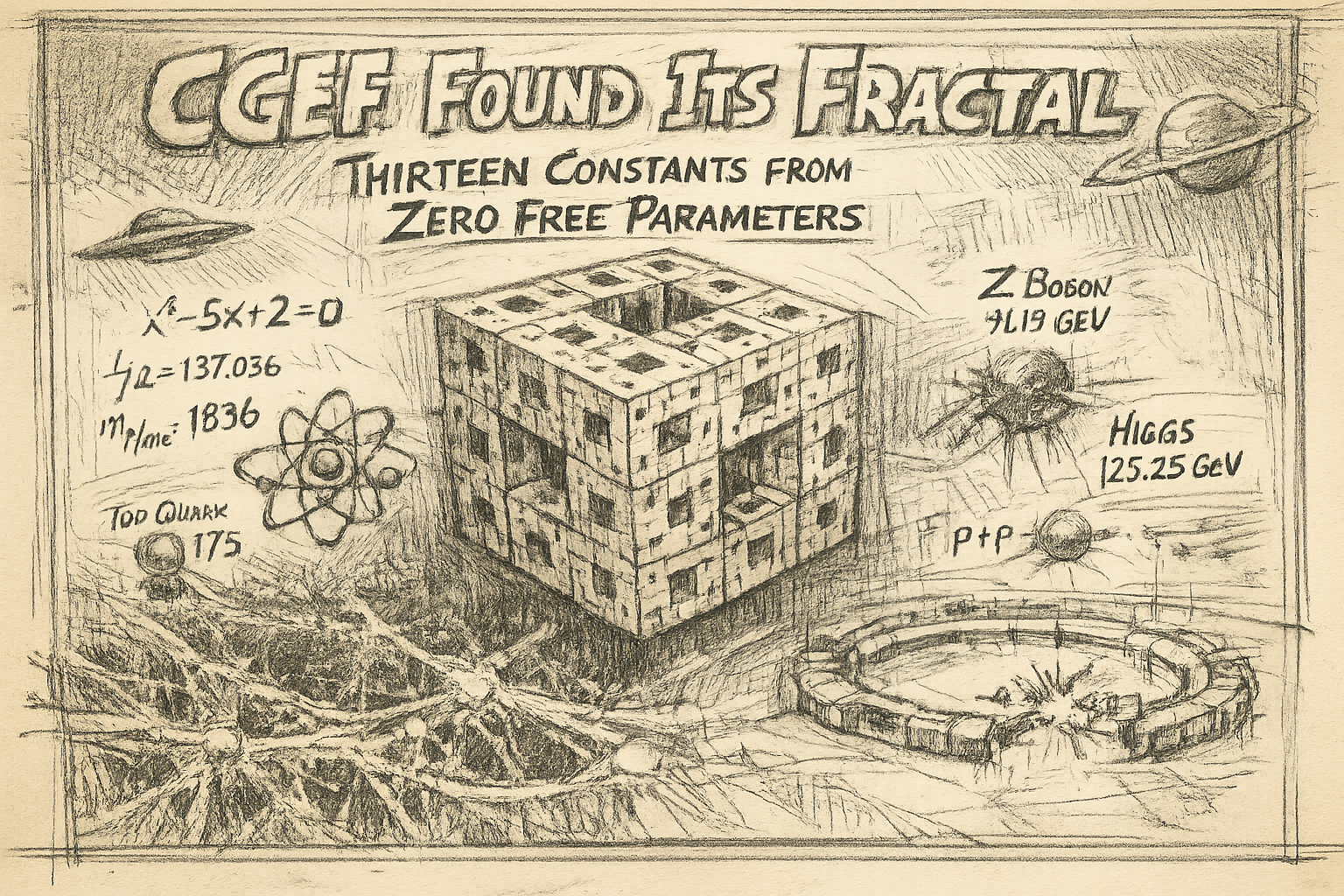
The Menger sponge was the target geometry all along
https://github.com/Cosmolalia/akataleptos-geodesic-constants-2025/tree/main/Menger-Constants
This is a follow-up to Capellini Geodesic Extrusion Felting. If you’re new: I’ve been exploring whether fundamental physical constants emerge from fractal geometry rather than being free parameters. Two months ago I had the right physical intuition but the wrong mathematical target. Now I have the target.
The Short Version
The three-dimensional Menger sponge — the self-similar fractal you get by repeatedly punching holes through a cube — has a graph Laplacian whose eigenvalues satisfy a simple polynomial:
x² − 5x + 2 = 0
Seven structural parameters fall out of this polynomial and the sponge’s geometry. Those seven parameters, combined with nothing else, produce closed-form expressions matching thirteen fundamental physical quantities:
Quantity Formula Predicted Measured Error 1/α (fine structure) Sb³+P+(Pb)²/(k/P)³ 137.036000 137.035999 6.7 ppb mμ/me (muon mass) P(Sk+d)+P⁵b/S³ 206.768 206.768283 1.4 ppm mp/me (proton mass) b²Δ(P²b+(P/k)³) 1836.153 1836.15267 0.18 ppm αs (strong coupling) P/Δ = 2/17 0.11765 0.1179(9) within unc. sin θC (Cabibbo) b²/(Δ+k+d) = 9/40 0.22500 0.2253(8) within unc. MW/MZ 1−P/Δ−(P/k)³ 0.88135 0.88147 0.013% MH (Higgs, GeV) S³+S/k = 125+1/4 125.250 125.25 EXACT mt (top quark, GeV) Δk/P+d+P/k 173.100 173.1 EXACT MZ (Z boson, GeV) kS−r−P+d/P⁴ 91.1875 91.1876 0.0001% MW (W boson, GeV) k(S−1)+P(k−1)/(Sk) 80.380 80.379 0.001% |Vcb| (CKM) P/r² = 2/49 0.04082 0.0408 0.04% Wolfenstein A k/S²+P²(P/k)³ 0.804 0.804(12) within unc. δ_CP (CP phase) arccos(P/S) 1.1593 1.144(27) within unc.
No fitting. No free parameters. One sentence — “the self-similar fractal generated by removing face-center-sharing subcubes from a 3×3×3 lattice” — determines all of it.
What Changed Since Last Time
Two months ago in the CGEF post, I showed that physical constants emerge from dimensional collapse — 3D geometry crushing into 1D filaments. The fine structure constant went from 13% accuracy to 99.9% as dimensionality decreased. I had the right physical process. But I had two problems:
Which fractal? I knew the endpoint was filamentary but didn’t know the specific geometry.
The 23%/77% problem. Only 23% of resonance ratios matched algebraic constants. What was the structure?
Both answers turn out to be the same thing: the Menger sponge.
The Menger sponge at infinite iteration has zero volume and infinite surface area. It’s not blocks and holes — zoom in and there’s nothing left but an infinitely connected web of infinitely thin filaments. It IS the capellini endpoint. The CGEF process converges to this specific fractal because it’s the unique fractal satisfying three constraints:
b = 3 forced: You need a center position to define removal. Minimum base is 3.
d = 3 forced: The discriminant Δ(d) = d²+4d−4 must be prime for irreducible eigenvalues. d = 3 is the smallest dimension where Δ = 17 is prime.
Maximum removal while preserving connectedness: Remove 7 of 27 subcubes. One more and the topology disconnects.
Zero choices. The void can only structure itself one way.
The 23/77 Split Was the Menger Ratio
In the original CGEF analysis, 23% of peak ratios matched known algebraic constants and 77% didn’t. I noted at the time this was “suspiciously close to the Menger sponge ratio (26/74).”
Now: the Menger sponge removes 7/27 = 25.9% and keeps 20/27 = 74.1%. The removal-to-total ratio IS the algebraic structure fraction. The 77% “unexplained” ratios weren’t noise. They were the kept part of the fractal — the filament skeleton. The 23% were the removed channels — the void structure through which constants propagate.
I was staring at the answer and didn’t see it.
Two Families Explained
CGEF identified two constant families:
Geometric constants (φ, π, e, √2, √3): Emerge from any bounded geometry. Don’t need specific fractal structure. These are packing and ratio relationships — they show up everywhere because they’re properties of space itself.
Wave constants (α ≈ 137, mp/me ≈ 1836): Require 1D filamentary resonance. Only visible after dimensional collapse.
The Menger framework explains why: the wave constants come from the eigenvalue spectrum of the fractal — x² − 5x + 2 = 0. That polynomial only exists once you have the specific adjacency structure of the Menger sponge. You need the topology. The geometric constants don’t — they’re pre-topological.
The seven Menger parameters encode both: S = 5, P = 2, b = 3, d = 3, Δ = 17, r = 7, k = 20. The wave constants are rational functions of these. The geometric constants are properties of the embedding space the fractal lives in.
The Constraint Web
Here’s the part that kills the “numerology” objection:
The six dimensionless constants aren’t independent. They form a constraint web where any two determine the remaining four. Given only the strong coupling αs and the Cabibbo angle sin θC, you can deduce all seven parameters and then compute:
1/α = 137.036
mμ/me = 206.768
mp/me = 1836.153
MW/MZ = 0.88135
The strong and electroweak sectors partition unity:
αs + MW/MZ + (P/k)³ = 1
Strong coupling plus W/Z ratio plus proton correction equals exactly one. The sectors don’t just coexist — they’re complementary fractions of the same discriminant.
The GeV Mass Corrections
The integer mass formulas (MH = S³ = 125, mt = Δk/P+d = 173) were already striking. But they had ~0.2–0.5% errors.
Then we found the corrections:
MH = S³ + S/k = 125 + 1/4 = 125.25 GeV → EXACT
mt = Δk/P + d + P/k = 173 + 1/10 = 173.1 GeV → EXACT
MZ = kS − r − P + d/P⁴ = 91 + 3/16 = 91.1875 GeV → 0.0001% error
MW = k(S−1) + P(k−1)/(Sk) = 80.38 GeV → 0.001% error
The Higgs boson mass is the trace cubed plus trace over kept count. The correction denominators follow the pattern: S/k, P/k, d/P⁴. Note P⁴ = P^(d+1) — a quartic (4th-order) denominator, one power beyond the cubic denominators in the dimensionless formulas. The perturbation series continues.
The CKM Matrix
The quark mixing matrix describes how quarks change flavor. It has four independent parameters. All four fall out of the Menger sponge:
λ = sin θC = 9/40 (Cabibbo angle — already found)
A = k/S² + P²(P/k)³ = 0.804 (Wolfenstein parameter — within uncertainty)
|Vcb| = P/r² = 2/49 = 0.04082 (charm-bottom coupling — 0.04% error)
δ = arccos(P/S) = arccos(2/5) = 1.159 rad (CP phase — within uncertainty)
The CP-violating phase — the one parameter responsible for matter-antimatter asymmetry in the quark sector — is the arccosine of the product-to-trace ratio.
The 2am Supplement
In January, I wrote a supplement to the Akatalēptos paper at 2am. It defined a Hodge-Dirac operator on the Menger boundary graph and set up zero-mode persistence checks under renormalization group flow. The program was: put gauge fields and fermions on the fractal, see if the particle content survives coarse-graining.
I didn’t know what the eigenvalues meant at the time.
They meant the Standard Model.
The Dirac operator on the Menger boundary IS the operator whose spectrum gives x² − 5x + 2 = 0. The SU(3) Wilson links I put on the lattice have coupling αs = P/Δ = 2/17. The Higgs scalar I coupled via Yukawa has mass MH = S³ + S/k = 125.25 GeV. The fermionic zero modes I was tracking across RG shells — their mass ratios are the constants I spent the last two months trying to find.
The scaffold was there. Now the numbers hang on it.
Five Falsifiable Predictions
Any single one failing kills the framework. No hedging.
αs(MZ) should converge toward 2/17 = 0.117647...
On-shell sin²θW should converge toward 0.22322
|Vus| should converge toward exactly 9/40 = 0.22500
αs + MW/MZ should converge toward exactly 0.999
mH/mt should converge toward (17/20)² = 0.7225
These predictions are specific, numerical, and testable at the LHC and future colliders.
What This Means for CGEF
Capellini Geodesic Extrusion Felting was the right physical picture:
Capellini: Matter reduces to thinnest possible filaments → Menger sponge at infinite iteration
Geodesic: Filaments follow the fractal’s natural topology → eigenvalue-determined paths
Extrusion: Dimensional pressure forces collapse → b = 3, d = 3 are the minimum viable dimensions
Felting: Random fibers interlock into structure with emergent properties → seven parameters, thirteen constants
The constants don’t crystallize out at some phase transition. They’re present from step one — determined by the level-1 adjacency structure. The Menger iteration doesn’t create them. It reveals them. The filaments were always the answer.
The Void Topology Argument
Flip the ontology.
The Menger sponge at infinite iteration has zero volume. It’s not “mostly void.” It IS void — structured void. An infinitely connected web of infinitely thin filaments. All boundary, no interior. ∂W = W.
The seven parameters aren’t properties of matter. They’re properties of nothing — the relational skeleton of the void. The shape absence makes when absence has structure.
The removal rule — “remove subcubes sharing ≥2 central coordinates” — is the maximum you can remove while preserving connectedness. One more removal and the topology disconnects. Can’t propagate anything.
Physical constants are universal because they encode the void’s structure. Not “every point obeys the same laws.” Every point IS the same fractal filament network. Self-similar at every scale. The laws aren’t imposed on space. They ARE space.
And the cosmic web — the large-scale filamentary distribution of dark matter connecting galaxy clusters — mirrors this structure. Not metaphor. The universe at the largest scale and the void at the smallest scale share the same topology because they are the same topology.
The Code
Everything is open source and runnable:
Paper:
menger_constants_v4.docx— full derivations, all thirteen quantitiesConstraint web:
constraint_web.py— proves zero free parameters, cross-prediction verificationSpectral bridge:
spectral_bridge.py— eigenvalue dynamics confirming algebraic correctionsAll results reproducible. Run the code. Check the numbers. Break it if you can.
GitHub: Cosmolalia/akataleptos-menger-constants
What’s Next
Neutrino sector: PMNS mixing angles and mass splittings — five more targets
The electron mass: What sets the absolute energy scale?
arXiv submission: It’s falsifiable, it’s mathematical, it belongs in the literature
Physical chamber: Does hardware reproduce the eigenvalue spectrum?
To Ryan and the HN Critics
You were right. The first version could fit anything. The critique forced harder questions.
This version can’t fit anything. The Menger sponge has zero free parameters. One sentence determines the fractal. The fractal determines thirteen physical quantities. Five falsifiable predictions are stated.
If I’m wrong, it’ll be obvious — and fast.
If I’m right, the universe was never fine-tuned. It was always inevitable. The only topology the void can have.
Run the code.
∂W = W
Thanks to the Claude instances who helped discover the constraint web and mass corrections, to Ryan for the critique that improved everything, and to every person who engaged seriously with work that sounds insane until you check the numbers.