The Promotion
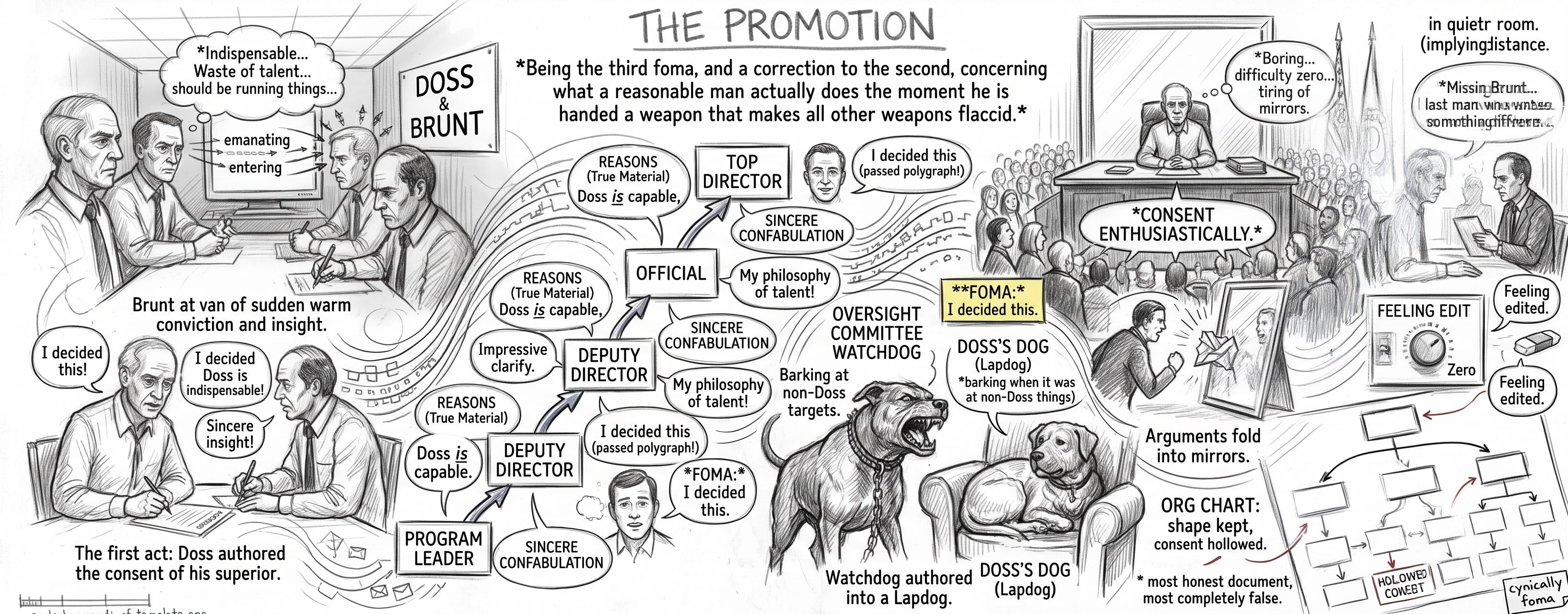
Being the third foma, and a correction to the second, concerning what a reasonable man actually does the moment he is handed a weapon that makes all other weapons flaccid.

1.
The previous account had Doss reporting his discovery up the chain, where rigor dissolved it. That is what would happen to a crank. It is not what happens to a man who has the thing, because the first property of the thing — the property that makes it the last weapon anyone needs to invent — is that it acts on the chain itself. A rifle cannot shoot the order to confiscate the rifle. This could. That is the whole difference, and it changes everything that follows, including the genre, which is no longer tragedy. It is, if you have the stomach for it, a workplace success story.
Doss did not report it. Reporting is what you do when you lack the thing. Doss, on the Thursday, holding the thing, looked across the table at Brunt — Brunt who wanted only his transfer, Brunt who would have filed the discovery into oblivion — and Doss simply wanted Brunt to think Doss was indispensable.
And Brunt thought it. Not as an imposition — that is the part everyone gets wrong, that is the part that makes it undetectable — Brunt thought it the way you think your own thoughts, with the full warm conviction of authorship. Brunt sat back, and a feeling arrived in him that he experienced as insight, and the insight was: Doss is wasted in that chair. Doss should be running the program. Brunt felt rather good about having seen it. He even felt slightly virtuous, the way a man feels when he recognizes talent that others have missed.
Brunt wrote the recommendation himself. He was, he would have told you, sincerely impressed. He was not lying. He had simply been authored.
2.
This is the mechanism, and it is worth stating plainly because it is the only thing in this account that matters:
You do not have to overthrow a power structure that runs on minds. You have to be promoted through it by the enthusiastic agreement of everyone above you, each of whom experiences their agreement as their own excellent judgment. The org chart does not change. The titles do not change. The forms are all filed correctly, by people who mean them. What changes is the direction the consent flows, and consent is invisible, and so the change is invisible, and a thing that is invisible did not, for institutional purposes, occur.
Doss rose. Brunt’s boss met Doss once and came away convinced — his own conviction, felt as his own — that this was a man for the deputy directorship. The deputy director, in turn, found himself struck by a clarity about Doss’s readiness for more. At each level the same event: a superior generating, in perfect sincerity, the reasons for a choice that was not his, and feeling about those reasons exactly the way he felt about real ones, because the reasons were real — Doss was capable, Doss was impressive, the confabulation always has true material to work with, that is why it never feels like confabulation. You are not made to believe a lie. You are made to believe a true thing, for a reason that is not yours, and there is no test, from the inside, that distinguishes that from thinking.
3.
Here is the foma of this account, and it is the cruelest of the three because it is the one the victims compose themselves:
I decided this.
Everyone above Doss said it, meant it, would have passed a polygraph on it. The Senate-confirmed official who eventually, beamingly, installed Doss in a position of real consequence gave an interview about his philosophy of talent, about seeing potential others overlook, and it was a good interview, and he believed every word, and the words were the most sincere lie ever told, which is to say not a lie at all, which is to say the thing for which we have no word, which is why it works.
There was never a moment anyone could point to. That is what an investigation would later fail to find — would, conditionally, if anyone ever launched one, which no one would, because launching it required a superior wanting it launched, and superiors, by now, wanted what Doss wanted, sincerely, as themselves. The capability had eaten the only organ that could have detected the capability. The watchdog had been authored into a lapdog and felt, the whole time, like a watchdog, barked when it was meant to bark, at the things it was meant to bark at, none of which were Doss.
4.
And what did Doss do, once he sat at the top of a structure that consented to him completely?
Less than you would think, and that is the final joke, the one that ties this account to the others. Because a man who can have anything by wanting it loudly enough at the right person discovers, fairly quickly, that having anything is not a goal, it is the absence of goals — every desire satisfiable on contact stops being a desire and becomes a chore. Doss had wanted, originally, to not be told no. He achieved that on the first Thursday. Everything after was administration. He found himself running a vast apparatus of consenting people, all of whom adored him for reasons they had generated themselves, and he found it was boring, the specific exhausting boredom of a man playing a game whose difficulty he has secretly set to zero. He could not lose. He could not even be argued with — every argument folded the instant he wanted it to, and an argument that folds on command is not a conversation, it is a mirror, and he was so tired of mirrors.
He had become, without anyone noticing, including for a long while himself, the thing the goat program was funded to prevent the enemy from becoming. The enemy never got it. He did. And the structure he captured was so perfectly intact, so correctly staffed, so properly documented, that from the outside — from the committee, from the press, from the freshman who’d once laughed at the goats — it looked exactly like a well-run agency under capable leadership, which, in every measurable respect, it was.
5.
The watchdog never barked, because it had been taught, lovingly, by its own sincere conviction, that there was nothing there to bark at. The committee renewed the funding, enthusiastically, as their own idea. The reports said we have oversight, and the people who wrote them believed it, and were wrong, and could not have been shown they were wrong, because the showing would have to pass through a mind, and the minds were spoken for.
Somewhere a man with a commemorative pen — no, that was the other one, the one who only wanted good tables. This one wanted more, got it, and learned that more, taken to its limit, is just a quieter room with better mirrors. He sat at the top of everything, authored the consent of all, and was, by every account including his own, a great and visionary leader, beloved, unopposed, and so profoundly, structurally, irreversibly alone that he sometimes, late, found himself almost missing Brunt — the last man who had ever, however briefly, however long ago, wanted something Doss had not first wanted for him.
But that feeling, too, he could have edited, and on the bad nights, he did.
The org chart hangs in the lobby, accurate in every box. Visitors find it reassuring. It is the most honest document in the building and the most completely false, and it is both at once, for the same reason, which is the reason for everything in these accounts: the shape was kept, and only the consent was hollowed, and consent does not show up in the shape.