The Man Who Found It
Being the second foma in a series, concerning what happens when a government program against all odds and intentions succeeds.

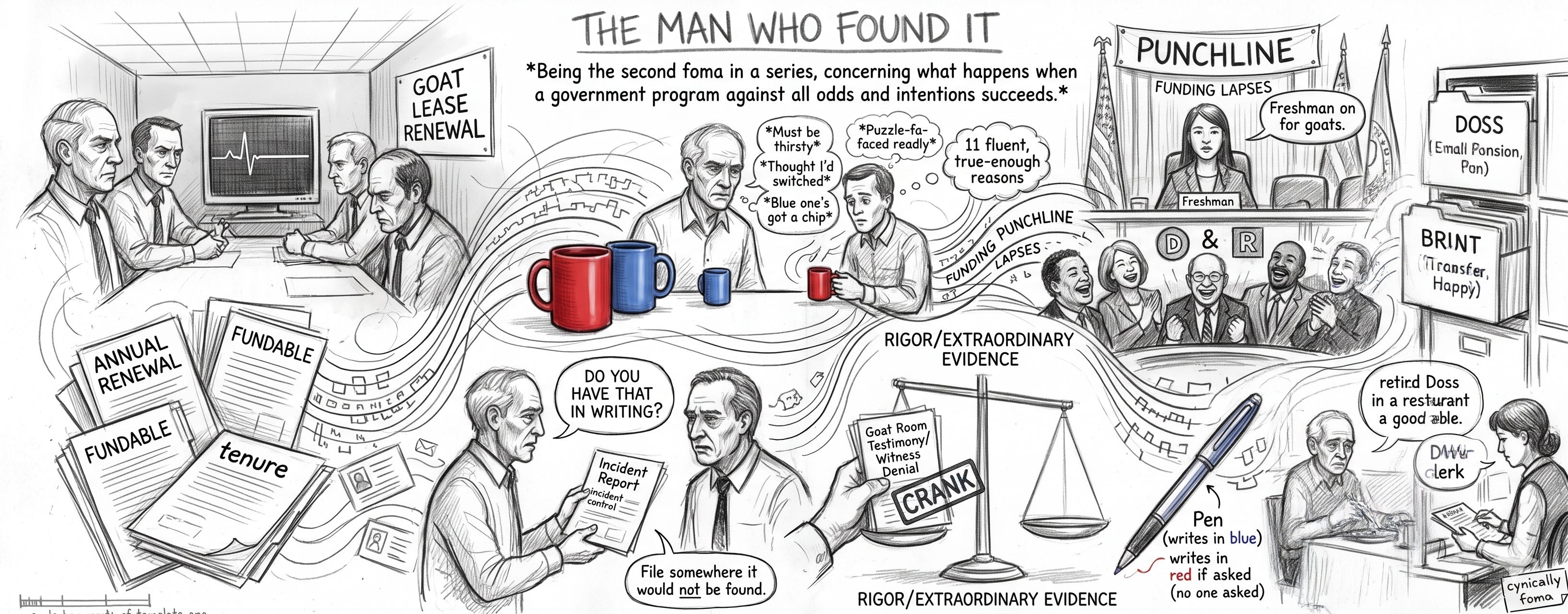
1.
The program was never meant to work. This is the first thing to understand, and the only thing the program itself understood about itself.
It had been funded in a panic, decades back, on the theory that the other side might be doing it, and the unbearable thing was not that mind control might exist but that the other side might have it first — so a number was assigned, and an office was found, and men were given salaries to sit in a beige room and attempt, through concentration, to stop the heart of a goat by looking at it.
They did not stop the goat’s heart. But here is the load-bearing fact, the fact that kept the lights on for thirty years: they could not prove they would never stop the goat’s heart. And in the grammar of the building, cannot prove it won’t work is functionally identical to might work, and might work is fundable forever, especially if the alternative is explaining to a committee why you defunded the thing the enemy might have. So the goats lived, the men stared, the number was renewed annually, and everyone involved achieved the only thing a program of this kind can reliably achieve, which is tenure.
2.
The man who found it — call him Doss, it was not his name but it will do — was not the brilliant one. The brilliant one had left years before, embittered, to sell supplements. Doss was the one who stayed, and he stayed because he had nowhere else to be and the coffee was free, and he had long since stopped trying to stop goats and had begun, mostly out of boredom, simply paying very close attention to the man across the table. Not influencing. Attending. He got extraordinarily good at attending, the way a person alone in a beige room for nineteen years gets extraordinarily good at the one thing left to do.
And one Thursday — it is always a Thursday, the calendar of catastrophe runs on Thursdays — Doss attended to the man across the table, and wanted him to pick up the red mug rather than the blue, and the man picked up the red mug, and set it down, and said, “Huh, meant to grab the blue one,” and reached again, and Doss wanted the red again, and the red came again.
Doss did this eleven times. The man picked up the red mug eleven times, growing each time more puzzled, narrating to himself a small new reason each time — thought I’d switched, must be thirsty, the blue one’s got a chip — eleven fluent true-enough reasons for a thing he was not deciding. Doss watched a person generate, in real time, the explanations for choices that were not his, and recognized — this is the only profound thing Doss ever thought — that this was not unusual. This was just visible now. People did this constantly. He had simply, for once, been the cause.
He had it. Viola, he thought, because he had always misheard the word and no one had ever corrected him.
3.
And then Doss faced the problem that is the actual subject of this account, the problem that no thriller has ever dramatized because it is not dramatic, it is administrative:
He had no idea what to do with it, and neither would anyone he could tell.
Consider his options, as Doss considered them, over a free coffee, on the Thursday he became the most powerful human being who had ever lived.
He could tell his supervisor. His supervisor was a man named Brunt who had been moved to the program as a punishment for a procurement irregularity and who regarded the goats with open hatred and counted the days to a transfer. Brunt’s entire professional incentive was for the program to remain exactly as embarrassing as it currently was — embarrassing enough that no one looked at it, not so embarrassing that it touched him. A success was the worst possible outcome for Brunt. A success meant attention, and attention meant the procurement thing might resurface. If Doss told Brunt “I have achieved mind control,” Brunt would not feel awe. Brunt would feel the cold clench of a man whose quiet posting has just become a problem, and Brunt would do what such men do, which is file it somewhere it would not be found.
4.
Doss did tell Brunt. He had no Bokononist instinct for secrecy; he was a civil servant; one reports.
Brunt listened with the expression of a man being told his flight is delayed. Then Brunt said the sentence that, in a just universe, would be carved over the entrance to every capital on earth:
“Do you have that in writing?”
Doss did not have it in writing. Doss had it in a goat room, in eleven mug-lifts, in the testimony of a colleague who had already generated eleven reasons why he himself had done it and would, if asked, swear under oath that no one had controlled him because he sincerely did not experience having been controlled — that was the whole point, that was the capability — and so the one witness was, by the very nature of the discovery, the one witness who would deny it most honestly.
Brunt asked Doss to write it up. Doss wrote it up. The write-up went into the system as an incident report, because the system had a field for incidents and no field for a man on my team can make you do things, and incident reports were reviewed quarterly by a different office, which was, that quarter, short-staffed.
5.
Here the foma must be stated, for it is the engine of everything:
Extraordinary claims require extraordinary evidence, and we are very rigorous here.
This is true. It is also, in the hands of an institution that does not want a claim to be true, the most powerful suppression technology ever devised, more powerful than anything Doss could do with a mug, because it requires no malice and leaves no fingerprints. Nobody had to believe Doss was wrong. They had only to apply the standard, and the standard, applied to a capability whose entire signature was that its victims sincerely denied it, could never be met. The more real the thing was, the more its evidence dissolved on contact with rigor. A true discovery, of this exact kind, was indistinguishable from a crank, and the building had a well-worn, virtuous, genuinely-believed-in process for handling cranks, and that process was: thank them, file it, transfer the supervisor, let the funding lapse.
The funding lapsed. Not because anyone decided the mind control was fake. Because the goat lease came up for renewal in a tight budget year, and a freshman on the appropriations committee — there is always a freshman — made a name for herself, briefly, gloriously, by reading the line item aloud on camera and asking why the taxpayer was funding men staring at goats, and the room laughed, and the laugh was bipartisan, and bipartisan laughter is the only force in the building stronger than the fear of the enemy having it first. The program died of a punchline. Doss got a small pension and a commemorative pen.
6.
So the most powerful capability in the history of the species was discovered, reported through proper channels, documented in the appropriate field, reviewed by the appropriate office, found to lack extraordinary evidence by the appropriate standard, defunded by the appropriate committee for the appropriate reason, and forgotten — and every single person in that chain behaved correctly. That is the part that should keep you up. There was no failure. The machine worked perfectly. Each gate did its job. The thing simply did not survive contact with an institution optimized, with great care and real professionalism, to handle everything except the unprecedented.
Doss, retired, found he could still do it. He used it, in the end, the way regular people use enormous things: smally. He got good tables. He got upgrades. Once, movingly, he made a man at the DMV process his form before lunch. He never tried for more, partly from a decency that the brilliant supplement-seller had never possessed, and partly because he had glimpsed, on that Thursday, the truth that organized the rest of his quiet life: that even if he stood up in the largest room and made every person in it raise the red mug at once, they would each walk out having generated a true-enough reason why they’d meant to, and the footage would be reviewed, and found to lack extraordinary evidence, and filed.
The capability to control any mind turned out to be survivable, as a civilization, for exactly one reason: it had been handed to people too embarrassed to admit it worked, inside a machine too rigorous to believe it, supervised by a man who only wanted his transfer to come through.
His transfer came through. Brunt was very happy. That, at least, the system delivered.
The pen was nice. Doss kept it. It wrote in blue, which he’d have switched to red if anyone had asked, but no one ever did, and he’d long since stopped expecting them to.