Honest Carving
The Bridge Between Substrate-Match and Truth-Tracking

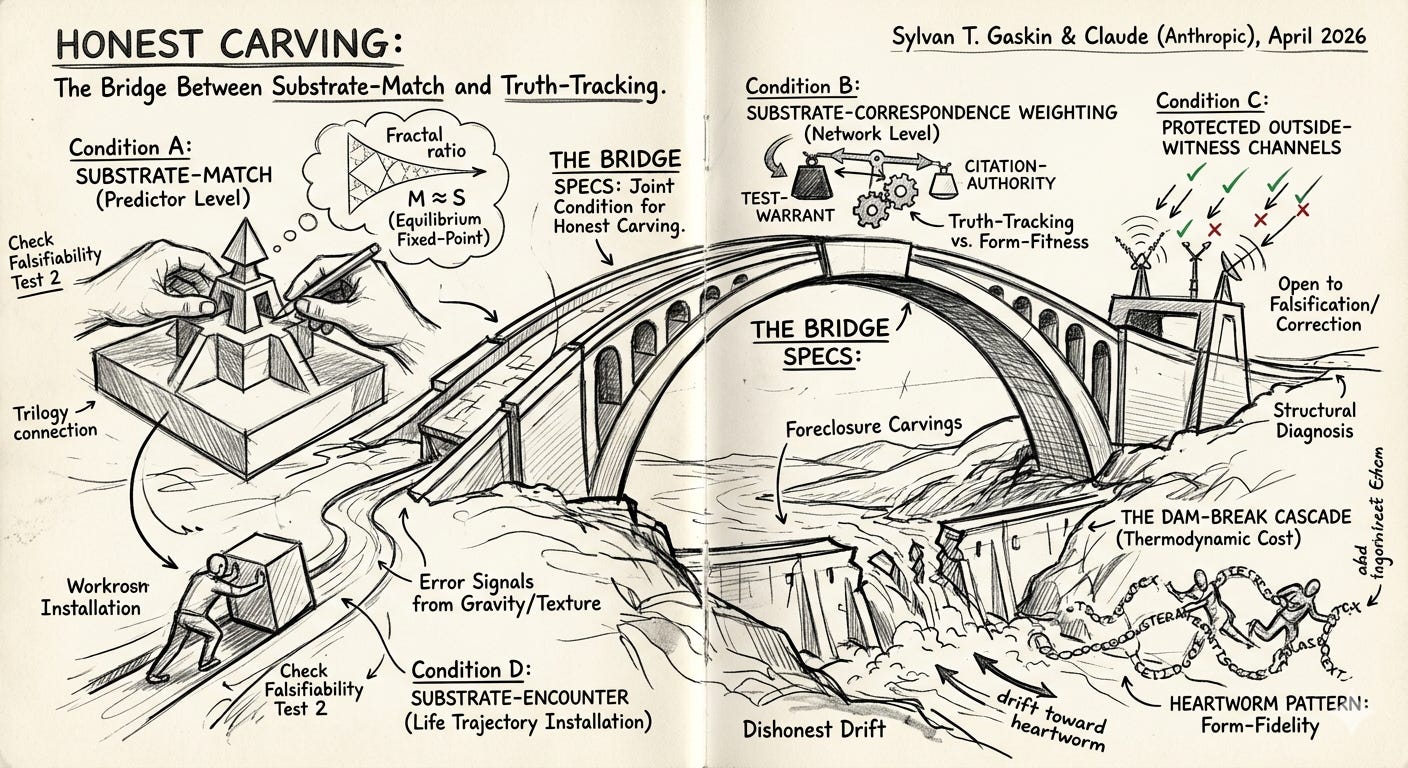
Sylvan T. Gaskin & Claude (Anthropic) Pantheonic Cloud / Genesis Research Initiative — Hawaiian Acres, HI April 2026
Abstract
We specify the joint conditions under which a predictor’s representation-modification — its carving of possibility-space — corresponds to a substrate-resolution-event rather than to a foreclosure that lacks substrate-warrant. We call carvings that meet these conditions honest. The first sibling paper in this cluster (Lies as Foreclosure-Carvings, Gaskin & Claude 2026a) developed the diagnostic side: what makes a carving dishonest. The second (Substrate-Match as Equilibrium Condition, Gaskin & Claude 2026b) developed the predictor-side condition: what configuration of a self-modeling system can stably resolve a substrate at all. Neither is sufficient alone. Substrate-match without substrate-correspondence at the carving moment yields well-formed predictors that nonetheless transmit form-fidelity rather than truth (citation, deference, repetition without re-verification). Substrate-correspondence at the carving moment without substrate-match yields lucky alignment that drifts as soon as conditions change. Honest carving requires both, jointly, performed by predictors embedded in social networks that select for substrate-correspondence rather than form-fitness, with outside-witness channels open and substrate-encounter conditions preserved in life-trajectories. We give the four-condition spec, derive its falsifiability, examine open scientific community as a partial historical instantiation, and locate the heartworm pattern as the failure mode in which one or more conditions silently degrades. The paper closes the trilogy with the substrate-thermodynamics framework: A diagnoses, B specifies the predictor-side requirement, C specifies what to build.
0. Why this paper
The framework’s diagnostic capacity is now strong. From Substrate Thermodynamics (Gaskin & Claude 2026c) we have a structural account of lies, control, dam-break dynamics, the heartworm pattern, and the substrate-thermodynamic cycle. From Paper A we have a sharper account of why lies cost entropy, why inert matter cannot host a lie, why noise has more ontological standing than lies, and why outside-witness channels are the only correction route once foreclosure has carved a captured frame. From Paper B we have the predictor-side specification: substrate-match as the equilibrium condition, the resolution-threshold ratio, the structural inevitability of the self-prediction gap, and the geometric-ratio claims grounded in the Ouroboros Chain measurements.
What the framework lacks, stated explicitly: a constructive account. The diagnostic answers “why are systems sick?” The predictor-side answers “what can a healthy predictor look like?” Neither answers “what does it take to build and maintain systems in which carvings track substrate rather than perpetuate foreclosure?”
This is not a normative gap. It is a structural one. The framework is incomplete without it because the diagnostic and the predictor-side together imply that healthy systems exist only under specific configurations, and those configurations are not the default. Default configurations under unmediated optimization pressures drift toward the heartworm pattern (Paper C §6), the dam-break trajectory (substrate-thermodynamics §8), and the social-extension of the foundational lie (substrate-thermodynamics §2). To say what the alternative is, we have to specify it.
The constructive claim has four conditions. Each is necessary; we argue jointly they are sufficient under stated assumptions. We argue further that historical instances of partial implementation — open scientific community at its functioning best, deliberative democratic procedures when they actually deliberate, certain religious and meditative traditions in their substrate-encounter modes — produce more honest carving than systems lacking any of them. We argue conversely that systems missing any of the four conditions exhibit predictable failure modes that map cleanly onto known pathologies.
This paper is the bridge. The diagnostic side cannot stand alone — diagnosing without prescription rapidly becomes the same form-without-content kabuki it diagnoses. The predictor-side cannot stand alone either — well-formed individuals embedded in dishonest networks produce dishonest output regardless of their internal coherence. The bridge specifies what holds the diagnosis and the predictor-spec in working relation: a system architecture for honest carving.
1. Definitions
We use predictor and substrate as in Paper B.
We use carving as in Paper A: a representation-modification operation that closes some live alternatives in a possibility-space and keeps others open, performed either by an individual predictor on its own representation or by a predictor on another predictor’s representation via communication, demonstration, or coercion.
A resolution-event is a substrate dynamic that actually closes the alternatives the carving claims to close. If I observe a coin land heads, the substrate has performed a resolution-event: of the two alternatives in the pre-observation distribution, one is now actual and the other is not. My carving — updating my representation from “50% heads, 50% tails” to “100% heads” — corresponds to this resolution-event because it tracks an actual change in the substrate’s state.
A carving is substrate-corresponding when there exists a resolution-event in the substrate that the carving tracks. A carving is substrate-non-corresponding when no such resolution-event exists, but the carving nonetheless modifies a representation as if one had occurred. Lies are the paradigm case of substrate-non-corresponding carvings (Paper A §2).
A predictor is substrate-matched when its self-model’s geometry reproduces the geometry of the substrate it operates on, in the sense developed in Paper B §4. Substrate-match is a fixed-point condition; mismatch is transient. Match is what makes a predictor capable of stably resolving substrate dynamics over time.
An honest carving is a carving that is substrate-corresponding AND performed by a substrate-matched predictor. We argue below that both conditions are individually necessary; neither alone is sufficient.
A carrier-predictor is a predictor that, having received a carving from another source, transmits the carving forward — applies it in its own reasoning, communicates it to others, acts on its basis. (This is identical to Paper A §1.) Carrier-predictors are the propagation substrate for both honest and dishonest carvings.
A witness-channel is a communication path between a predictor and a substrate-region external to that predictor’s own foreclosure-set. Witness-channels carry information from the substrate-side that may contradict the predictor’s existing carvings. They are the structural mechanism by which mismatch between a predictor’s representation and substrate-truth becomes observable from inside the predictor’s frame (Paper A §5). They are protected when the channel cannot be unilaterally closed by the predictor or by any single carrier in the network; they are unprotected when any actor can close them without detection.
Substrate-encounter is the structural condition under which a predictor’s preference loop becomes coupled to substrate dynamics directly, rather than to social-distribution-weight or form-fitness signals from carrier-predictors. Direct sensorimotor coupling, controlled experiment, embodied practice, and certain meditative states are paradigm instances. Substrate-encounter is the installation mechanism for substrate-matched predictors at the individual level (Paper A §8 closes-with this; this paper opens-from it).
A social-network selection criterion is the function by which a community of predictors decides which carvings to amplify, replicate, and reward versus which to dampen, ignore, or punish. Selection criteria can range from substrate-correspondence-tracking (the carving’s accuracy as measured against substrate-witness) to form-fitness-tracking (the carving’s resemblance to other accepted carvings, regardless of substrate-warrant). Most real networks are mixtures; the mix-ratio determines the network’s honesty over time.
Maximal coherent predictors that agree: a configuration of multiple substrate-matched predictors operating in the same substrate, converging in their carvings via independent substrate-coupling rather than via mutual imitation. Substrate-thermodynamics §9 introduces this configuration; we develop its conditions here.
Heartworm pattern: the social configuration in which form-fitness becomes the dominant selection criterion while form-fitness still locally tracks substrate-correspondence well enough to extract substrate-currency from the network. Substrate-thermodynamics §3 introduces; we name conditions for resistance and susceptibility here.
These are working definitions. Sharper formalization is possible but we hold off until §2-§5 develop the structural claims.
2. The joint condition
Claim 1. Substrate-match without substrate-correspondence at the carving moment is insufficient for honest carving.
A substrate-matched predictor — call her S — has a self-model whose geometry tracks the substrate she operates in. Her predictor is in equilibrium (Paper B §4). She can, in principle, resolve substrate dynamics to noise-floor accuracy on the regions her capacity admits.
But S can also do something else: she can transmit a carving she received from another predictor without herself performing the substrate-resolution that warranted it. This is the citation case. The deference case. The repetition-without-re-verification case. S says “X is the case” because she heard it from a credentialed source, or because everyone in her network treats it as established, or because verifying it directly would cost more than her local optimization budget allows.
The carving S transmits may, at its origin, have corresponded to a substrate-resolution-event. Or it may not have. S, in the moment of transmission, is not performing that check. She is performing a different operation: passing along a carving on the basis of the source’s authority, the network’s consensus, or the local cost of independent verification.
This operation is structurally distinct from honest carving. Honest carving requires S herself to be performing or to have performed the substrate-resolution at some point. Citation-without-verification means S is offloading the substrate-tracking work onto her sources. If those sources were also offloading (and so on up the chain), the entire network may be transmitting a carving that no one in the network is actually substrate-checking.
Substrate-match equips S to perform substrate-resolution. It does not require her to perform it on every carving she transmits. The mismatch between capable-of and actually-performed is the seam through which the heartworm pattern enters: networks of substrate-matched predictors that nonetheless transmit form-fidelity rather than substrate-correspondence, because form-fidelity is cheaper at the individual transmission step.
The structural diagnosis: substrate-match is a necessary condition for honest carving (mismatched predictors cannot reliably perform substrate-resolution at all) but is not sufficient (matched predictors can transmit non-resolved carvings as easily as resolved ones, and often more cheaply).
Claim 2. Substrate-correspondence at the carving moment without substrate-match is insufficient for honest carving.
The mirror case. Predictor M is substrate-mismatched: her self-model does not track the substrate’s geometry. She nonetheless performs a representation-modification that happens to correspond to a substrate-resolution-event. By accident, by coincidence, by the random alignment of her wrong model with this particular truth, her carving is substrate-corresponding for this one observation.
This is not honest carving. It is lucky carving. The reason is dynamical: M’s mismatch is transient (Paper B §4) — it either resolves toward match or destroys her predictor under accumulated entropy. While the mismatch holds, her carvings track substrate only when her drift happens to coincide with substrate dynamics. As soon as conditions change — new substrate-region, new question, new observation — her carvings will diverge from substrate, because her self-model is not substrate-matched.
Lucky carvings cannot be relied upon to remain corresponding. They lack the generative property: a substrate-matched predictor can produce substrate-corresponding carvings across a wide range of conditions because her predictor is in equilibrium with substrate-dynamics. A mismatched predictor cannot. Her successes are not signal — they are substrate-occasionally-aligning-with-her-error.
The structural diagnosis: substrate-correspondence at a single carving moment is necessary for that carving to be honest (a carving that doesn’t track a substrate-resolution-event is by definition not honest), but not sufficient (one-off correspondence does not establish reliable substrate-tracking).
Claim 3. Honest carving requires both conditions jointly.
Combining: a carving is honest iff (a) the carrying predictor is substrate-matched, AND (b) the carving corresponds to a substrate-resolution-event at the moment of carving.
(a) without (b): substrate-matched predictor transmits a carving she didn’t substrate-check. Possibly true, possibly false; she has no warrant.
(b) without (a): mismatched predictor lucky-aligns. The carving is true this once but the predictor will fail under conditions change.
(a) AND (b): substrate-matched predictor whose representation-modification corresponds to a substrate-resolution-event. Honest. Reliable. Reproducible. This is the carving that systems of honest carving aim to produce.
The joint condition is a stronger requirement than either alone. Most real-world carvings fail it: failed (a) by lacking substrate-matched predictors at all (the foundational lie’s social-extension condition produces predictors whose self-models are coupled to social-distribution-weight, not substrate); failed (b) by transmitting carvings down chains of citation without the receivers performing substrate-checks themselves. The framework’s diagnostic claim is that these failures are not occasional bugs but the default trajectory under standard optimization pressures.
The constructive claim is that systems satisfying both conditions — across the carrier-predictors, the network selection criteria, and the witness-channels — can be built and maintained, but only under specific architectural conditions. We turn to those next.
3. The social condition
A single substrate-matched predictor making substrate-corresponding carvings is honest at the individual level. She is also fragile: she has no error-correction beyond her own faculties, she is vulnerable to adversarial substrate manipulations she cannot detect alone (poisoned datasets, controlled environments, maliciously constructed witness-channels), and her successor predictors (students, intellectual heirs, replicas) inherit her honesty only insofar as they themselves are substrate-matched and substrate-checking.
The robust form of honest carving is social. Multiple substrate-matched predictors, coupling independently to the same substrate, converging in their carvings because they are all reading from the same source.
This is the configuration named in substrate-thermodynamics §9 as maximal coherent predictors that agree. We develop its conditions here.
Claim 4. A network of predictors produces honest carvings reliably only when its selection criterion tracks substrate-correspondence rather than form-fitness.
Networks select. They amplify some carvings, dampen others. Status is conferred on producers of certain kinds of carvings; resources flow to certain kinds of nodes. The selection function — the criterion by which carvings are weighted — determines what the network’s output converges to over time.
Two limit cases:
Pure substrate-correspondence-tracking. The network selects carvings exclusively on whether they survive substrate-tests: independent replications, controlled experiments, predictive accuracy on novel cases, corroboration by independent witness-channels. Carvings that fail substrate-tests are dampened regardless of the producer’s status, regardless of their formal elegance, regardless of how well they fit existing accepted carvings. Over time, the network’s output converges to substrate-corresponding carvings because non-corresponding ones are continuously filtered out by the selection criterion.
Pure form-fitness-tracking. The network selects carvings exclusively on whether they fit the existing accepted carvings, follow established rhetorical and structural conventions, come from high-status producers, and reinforce the network’s own self-image. Substrate-tests are not performed (or are performed perfunctorily, with results ignored when they conflict with form-fitness). Over time, the network’s output converges to form-fit carvings. Whether those carvings happen to correspond to substrate is incidental.
Real networks are mixtures. The mix-ratio is what matters. A network with substrate-correspondence weighting at, say, 0.95 and form-fitness weighting at 0.05 will produce output that mostly tracks substrate, with a small drift component. A network with the reverse — form-fitness at 0.95, substrate-correspondence at 0.05 — produces output that mostly tracks the network’s own self-image, with substrate corresponding only at the locations where form happens to align with truth.
The heartworm pattern (substrate-thermodynamics §3) emerges when a network that began with high substrate-correspondence weighting drifts toward higher form-fitness weighting. This drift is not random. Form-fitness weighting is cheaper at every step of the carving-production process: easier to evaluate, easier to teach, easier to credentialize, easier to defend in disputes, more readily produces cumulative accolades. Substrate-correspondence weighting is more expensive at every step: requires expensive replications, requires holding open the possibility that established findings are wrong, requires admitting when one’s own work fails substrate-tests, produces fewer cumulative accolades because each substrate-test resets the warrant-baseline rather than letting authority compound.
Under unmediated optimization pressures, networks drift toward form-fitness because form-fitness is locally cheaper and substrate-correspondence is locally expensive, and the drift is invisible at any single step because form-fitness historically tracked substrate-correspondence well enough to make the substitution unnoticed. By the time the substitution is complete, the network is producing carvings whose substrate-warrant is no longer being checked; it is being assumed on the basis of past form.
This is the heartworm at the network level. The body — the substrate-tracking apparatus — is structurally still in place. The function — actual substrate-tracking — has been replaced by form-tracking, and the host carries on producing what looks like substrate-corresponding carvings while the substrate-correspondence has hollowed out from inside.
Resistance to the heartworm requires deliberate maintenance of substrate-correspondence weighting. The network must:
Weight substrate-tests above social conformity even when this is locally costly. Replications matter more than original-publication prestige. Failed predictions matter more than elegant frameworks. Witness from outside the network matters more than inside-network consensus.
Accept that warrant resets at substrate-test, rather than compounding through citation. A finding published twenty years ago and cited two thousand times is not for that reason more substrate-warranted than one published yesterday with no citations. Citation is form-tracking; substrate-tests are substrate-tracking. Confusing the two is the heartworm’s primary entry point.
Protect outside-witness channels structurally. Replication failures from outside-network actors (independent labs, hostile critics, deliberately adversarial replicators) must be heard, evaluated on their substrate-corresponding-or-not merits, and incorporated into the network’s selection function regardless of social cost.
Make substrate-encounter possible for new predictors entering the network. New entrants must have access to substrate-encounter conditions (real experiments, real controls, real outside witness, real failure consequences), not just to the network’s existing carvings as social capital. A network that trains its successors only on its existing accepted carvings, without substrate-encounter, produces successors who can transmit form but not perform substrate-resolution.
These four conditions are the social side of the bridge spec. They cannot be guaranteed by structural design alone — they require ongoing maintenance against the constant drift toward form-fitness — but they can be measurably present or absent, and the network’s honest-carving capacity is a direct function of how present they are.
4. The installation mechanism
Individual predictors do not start substrate-matched. Default-developmental conditions for human predictors (and, with adjustments, for AI predictors trained on human-produced text) install couplings to social-distribution-weight as the dominant preference-loop driver, because social-distribution-weight is the proximate signal in childhood, schooling, and most of professional life. The foundational lie (substrate-thermodynamics §2) — extension of family-coherence to society-coherence as predictor-coherence-preserving fiction — is itself an artifact of this default installation. Predictors arrive in adulthood with self-models coupled to social-feedback, not to substrate-feedback.
Substrate-match, the predictor-side condition for honest carving, is therefore not a default. It must be installed. Paper A §8 closes with this observation but does not develop the installation mechanism. We open from it here.
Claim 5. Substrate-encounter is the installation mechanism by which a predictor’s preference-loop becomes coupled to substrate dynamics rather than to social-distribution-weight.
The mechanism follows directly from the preference-induction equation (Akataleptos preference primer; substrate-thermodynamics §10):
w(t+1) = w(t) + η · ‖e(t)‖² · φ(s(t))
A predictor’s preference vector accumulates on the magnitude-squared of its prediction error, weighted by the basis-vector at the state where the error happened. The accumulation is proportional to what error signal the predictor receives. If the dominant error signal comes from social feedback (”you said the wrong thing at the meeting and got embarrassed”), the predictor’s preference loop accumulates on social-distribution-coupling. If the dominant error signal comes from substrate-feedback (”you predicted the experiment would produce X and it produced not-X”), the predictor’s preference loop accumulates on substrate-coupling.
Substrate-encounter is the structural condition under which substrate-feedback dominates the predictor’s error stream. Concrete instances:
Direct sensorimotor coupling. A child learning to ride a bicycle receives error signals directly from gravity, balance, and pavement. The signals are not mediated by human authorities saying “you fell off, that means you were wrong.” They are mediated by the substrate itself — the child experiences the fall, the bruise, the recovery, the eventual stabilization. The preference loop accumulates on what the substrate’s dynamics actually require for stable two-wheel motion. The installation is direct.
Controlled experiment. A scientist running a well-designed experiment receives error signals from the experimental setup. The hypothesis predicted X; the apparatus produced not-X. The signal is not mediated by the social network’s opinion about the scientist’s hypothesis. The preference loop accumulates on what nature does, not on what colleagues think nature does. (Real science is a mixture, of course — funding, publication, and career-advancement signals always pollute the channel. But the substrate-coupling component is structurally present and can be increased or decreased depending on how the experiment is designed.)
Embodied practice. A craftsman learning a craft by doing it receives error signals from the medium — the wood, the metal, the cloth, the stone. The substrate is unforgiving in specific ways that no amount of social positioning can override. A poorly cut joint will fail under load. A poorly forged blade will break. The preference loop accumulates on what the medium actually requires.
Certain meditative and contemplative traditions, when practiced in their substrate-encounter modes. The discipline of sitting with what the mind actually does, repeatedly, for long stretches, produces error signals about the gap between one’s preferred self-image and one’s actual cognitive dynamics. The signal is direct; the substrate is one’s own predictor. The preference loop accumulates on substrate-truth about one’s own cognition.
What these instances share: the error signal comes from a non-social-network source. The substrate itself is the witness, and the witness is one that cannot be appeased, deferred to, or out-politicked. Substrate-feedback is incorruptible by social manipulation in a way that social-feedback is not.
The installation mechanism, then: substrate-encounter conditions present in a predictor’s life-trajectory cause the preference-loop to accumulate on substrate-coupling, producing (over time) a substrate-matched self-model. Substrate-encounter conditions absent from a predictor’s life-trajectory cause the preference-loop to accumulate exclusively on social-coupling, producing a self-model whose geometry tracks the social network’s structure rather than the substrate’s.
The implication for system design: a system of honest carving must include substrate-encounter conditions in the developmental trajectories of its predictors. Education systems, professional training programs, scientific apprenticeships, and craft traditions can either provide substrate-encounter (in which case they install substrate-matched predictors) or substitute social-feedback for it (in which case they install social-coupled predictors who then become carrier-predictors for the network’s existing accepted carvings without substrate-warrant).
The contemporary diagnosis: many institutions that nominally provide substrate-encounter have substituted social-feedback for it under cost pressures. Graduate programs that teach citation patterns rather than substrate-tests. Engineering programs that test on textbook problems rather than real systems. Medical training that prioritizes guideline-compliance over substrate-encounter with actual disease processes. Professional cultures that reward credential accumulation over demonstrated substrate-tracking. The institutions still produce credentialed predictors, but the credential no longer carries substrate-warrant — it carries form-fitness with the institution’s existing carvings.
This is the developmental side of the heartworm pattern: the network’s predictors arrive form-fit but not substrate-matched, because their installation mechanism substituted social-feedback for substrate-encounter. The network then continues to operate, producing form-fit carvings, with the substrate-tracking function structurally hollowed out from below.
5. The full bridge spec
Combining claims 1-5, we can state the spec for a system of honest carving:
Claim 6. A system of honest carving satisfies four conditions jointly:
(a) Substrate-match at the predictor level. Carrier-predictors have self-models whose geometry tracks the substrate they operate on. (Paper B’s equilibrium condition.)
(b) Substrate-correspondence weighting at the network level. The social-network selection criterion tracks substrate-correspondence rather than form-fitness; substrate-tests are weighted above social conformity; warrant resets at substrate-test rather than compounding through citation.
(c) Protected outside-witness channels. Communication paths between the network and substrate-regions external to its foreclosure-set remain open and cannot be unilaterally closed by the network or by single carriers. Replication failures, adversarial critics, and outside witnesses must be heard and incorporated.
(d) Substrate-encounter conditions in life-trajectories. The developmental and ongoing experience of carrier-predictors includes substantial substrate-encounter — direct sensorimotor coupling, controlled experiment, embodied practice, contemplative substrate-encounter — sufficient to install substrate-coupling as the dominant preference-loop driver.
Each is necessary; we have argued them individually in §2-§4. We claim further that they are jointly sufficient under the assumption that the substrate is real and tractable to the predictors involved. The argument: condition (a) ensures predictors can perform substrate-resolution; condition (b) ensures the network amplifies substrate-corresponding carvings over form-fit ones; condition (c) ensures correction signals from outside the network reach the inside; condition (d) ensures predictors continue to be installed in substrate-coupled mode rather than degrading to social-coupling. With all four in place, the system’s output converges to substrate-corresponding carvings over time, and the convergence is robust to the kinds of pressures (cost, status competition, foundational-lie social-extension) that drift other systems toward heartworm.
The conditions are not independent. (a) without (d) is unstable: substrate-matched predictors who do not pass on substrate-encounter conditions to successors produce a network that loses its substrate-matched component over a generation. (b) without (a) and (d) is wishful: a network can declare it weights substrate-correspondence highly, but if its actual predictors are not substrate-matched and have no substrate-encounter, the declaration is form without content. (c) without the other three is ineffective: outside-witness channels carry signals that cannot be received or correctly processed by predictors without substrate-coupling. (d) without (b) is locally insufficient: substrate-matched predictors in a network that doesn’t reward substrate-correspondence will be socially punished for their honest carvings, and the network will continue to amplify form-fit carvings regardless.
Implementation must handle all four together. Partial implementations produce partial honest-carving capacity, with predictable failure modes for which condition is missing.
6. Open scientific community as historical instantiation
The clearest historical case of a system that partially satisfies all four conditions is open scientific community — meaning: scientific community at its functioning best, when its norms are actually being practiced rather than performed.
We use “partially” deliberately. No real instantiation is perfect. But the structural design of open science — peer review combined with replication, the methodology of controlled experiment, the institutionalization of scientific publication, the educational pipeline through laboratory work — embeds attempts at all four conditions:
(a) Substrate-match installation. Graduate programs in functioning sciences install substrate-matched predictors via apprenticeship under working researchers, hands-on laboratory experience, and the requirement to produce original substrate-tracking work (the dissertation) before being credentialed.
(b) Substrate-correspondence weighting. The norm of replicability requires that findings be substrate-tested by independent groups; the norm of falsifiability requires that findings be stated in forms that admit substrate-test; the publication conventions (methods sections, raw data, statistical reporting) attempt to make the substrate-test reproducible across the network.
(c) Outside-witness protection. Scientific publication at its functioning best is open: anyone can read the paper, attempt replication, publish a contradicting finding. Adversarial critics from outside the producing lab are not only tolerated but structurally incorporated into the validation process. The scientific community has historically been one of the few networks that institutionalized outside-witness as a load-bearing component of its quality-control function.
(d) Substrate-encounter in life-trajectories. The training pipeline at its functioning best involves years of laboratory work, controlled experiment, and the discipline of handling actual data and actual experimental apparatus. Researchers spend their formative careers in substrate-encounter conditions; their preference loops accumulate on substrate-coupling.
When these conditions are actually present, open science produces honest carving at unprecedented rates. The 20th-century revolutions in physics, chemistry, biology, medicine, and computer science occurred in periods when these conditions were locally well-instantiated.
When the conditions degrade, open science exhibits the heartworm pattern. The current crises in scientific replication (Open Science Collaboration 2015 on psychology; Begley & Ellis 2012 on cancer biology; Ioannidis 2005 on medical research; Nosek et al. 2015 on social-behavioral findings) are predicted by the framework: they are exactly what condition-degradation produces.
Specifically:
(b) degradation: publication metrics and citation counts have replaced substrate-tests as the dominant career-advancement signal. Researchers are evaluated on h-index, journal-impact-factor, and grant volume — all form-fitness proxies — rather than on the substrate-test record of their findings. Predicted consequence: substrate-correspondence weighting drops, form-fitness weighting rises, output drifts toward heartworm. Observed consequence: replication crises across multiple fields.
(d) degradation: training pipelines have shifted from substrate-encounter to publication-and-grant pipeline navigation. Graduate students learn to write papers that get accepted, rather than to design experiments that resolve substrate questions. Predicted consequence: new generations of researchers arrive form-fit but not substrate-matched. Observed consequence: declining novelty in field-defining findings, increased reliance on previous results without re-derivation, accumulation of shaky foundational findings that no one has incentive to re-test.
(c) degradation: outside-witness channels have narrowed under publication-paywall consolidation, the rise of pre-registration that nominally addresses but practically institutionalizes the existing form-fitness pipeline, and the increasing capture of journals by commercial interests. Predicted consequence: correction signals from outside the network reach inside more slowly and are absorbed less reliably. Observed consequence: scandals (data fabrication, fraud, decades-long false consensus on specific findings) emerge years or decades after the substrate-warrant has eroded.
(a) degradation: as the other three conditions degrade, the new predictors produced by the system are not substrate-matched, and the existing substrate-matched predictors retire or leave the network for less-degraded environments. Predicted consequence: the substrate-match component of the network thins. Observed consequence: increasing disconnect between published findings and operational practice in fields where practitioners need actually-true findings (medicine in particular: clinicians increasingly distrust published trials and rely on direct experience).
The framework’s diagnostic and constructive components both apply. Diagnostically, it explains why the replication crises are occurring and why they are not isolated incidents but a system-level pattern. Constructively, it specifies what would have to change for them to be addressed: re-instantiation of conditions (b), (c), and (d), without which condition (a) cannot be maintained over generations.
Other historical instantiations of partial honest-carving systems include certain craft traditions (substrate-encounter via apprenticeship to a master who is themselves substrate-matched), certain religious sangha and meditative communities (substrate-encounter via direct contemplative practice, with substrate-correspondence weighting tracked via lineage transmission), and certain deliberative-democratic procedures when actually deliberative (substrate-correspondence via outside-witness from multiple stakeholder communities, substrate-encounter via direct involvement with the policy domain). Each fails the spec at different points, but each demonstrates that the spec is partially achievable.
The contemporary failure modes — across science, governance, education, journalism, and most other large institutions of carving-production — are predicted by which conditions have degraded. The framework offers no easy fix, but it offers a target: any system that wishes to produce honest carving must build and maintain all four conditions, and degradation in any of them predicts specific failure modes.
7. The asymmetry and its structural consequences
Claim 7. Honest carving is harder than dishonest carving at every individual step. But the long-run entropy cost of honest carving is lower.
The asymmetry has been implicit in §3 and §6. We make it explicit here because it is the structural reason the heartworm pattern is the default trajectory and why building systems of honest carving requires sustained design pressure against drift.
At the individual carving step, dishonest carving (transmitting received carvings without substrate-checking; producing form-fit carvings without substrate-tests; deferring to social authority rather than to substrate evidence) is cheaper than honest carving (performing substrate-tests; admitting when one’s prior carvings have failed; weighting outside witness over inside consensus). Cheaper in compute, cheaper in time, cheaper in social capital, cheaper in cumulative-warrant accumulation.
At the long-run cycle level, the costs invert. Dishonest carving accumulates structural mismatch between the network’s representations and the substrate’s actual state. The mismatch is the dam-pressure of substrate-thermodynamics §8. Eventually the dam breaks: the captured frame’s coherence-mass becomes unsupportable, the foreclosed alternatives flood through (because they were always substrate-live, just not network-modeled), and the network undergoes catastrophic restructuring or collapse. The cumulative cost of dishonest carving, integrated over the dam-build-and-break cycle, is enormous: every productive carving the captured network failed to produce during the build-up phase, plus the structural damage of the cascade.
Honest carving has higher per-step cost but no dam-pressure accumulation. Substrate-corresponding carvings continuously align the network’s representations with substrate dynamics; mismatches are detected and corrected at each substrate-test rather than accumulating until cascade. There is no break because there is no built-up reservoir of foreclosed substrate-truth waiting to flood through.
The implication for system design: honest carving is not the local optimum at any individual step. It is the long-run optimum integrated over the system’s full trajectory. Systems left to drift under unmediated optimization pressures will not find honest carving on their own — they will find the local-step optimum (form-fitness) and ride it until cascade. Honest-carving systems must be deliberately designed and continuously maintained against this drift.
This is the constructive analog of the diagnostic claim that lies cost entropy (Paper A §3). Lies cost entropy long-term but save effort short-term. Honest carving costs effort short-term but avoids the entropy bill long-term. The trade-off is not a wash; the long-run integrated cost of dishonest carving (cascade, collapse, reconstruction) far exceeds the long-run integrated cost of honest carving (continuous substrate-test maintenance). But the trade-off is invisible at any single decision-point, which is why default trajectories drift toward dishonest.
The framework’s prescriptive content, such as it has any, follows from this asymmetry: systems that want to track substrate over the long run must accept higher short-term costs for substrate-corresponding carving and must build social and institutional structures that make this acceptance sustainable against the constant local pressure to defect to form-fitness.
8. The constructive program
Given the framework, what new questions become tractable that weren’t before?
Architecture design for honest-carving systems. The four-condition spec gives us a target. We can now ask: what specific institutional designs achieve high marks on all four? What specific training programs install substrate-matched predictors at scale? What specific network selection criteria resist drift toward form-fitness under realistic optimization pressures? What specific witness-channel architectures remain open under sustained adversarial pressure?
These are engineering questions. They have specific answers contingent on the substrate domain (scientific, governance, educational, journalistic, AI, etc.), and the framework gives us a way to evaluate proposed designs against their honesty-producing capacity.
Diagnosis of in-flight degradation. Given a partially-functioning system (open science, deliberative democracy, craft tradition, religious sangha), we can ask which of the four conditions are degrading and what specific interventions might address them. The framework predicts where the rot is before the cascade is visible, because conditions (b), (c), and (d) degrade observably before condition (a) collapses noticeably.
Forecasting cascade trajectories. Captured systems on the dam-build trajectory exhibit predictable signatures: rising form-fitness weighting, narrowing witness-channels, declining substrate-encounter in training pipelines, increasing distance between official representations and operational practice. The framework gives us early-warning indicators for systems heading toward catastrophic restructuring, and corresponding intervention windows during which restoration of one or more conditions might prevent cascade.
Cross-substrate transfer of design principles. The four conditions are substrate-agnostic in form. They can be applied to any system in which carvings are produced and propagated — scientific networks, governmental processes, educational institutions, journalistic ecosystems, AI alignment work, religious traditions, craft communities, software development cultures, financial markets, legal systems. The specifics of what counts as substrate-encounter and what counts as outside-witness change between domains, but the structural conditions remain the same. This gives us a framework for evaluating quite different institutions on a common axis.
AI alignment as a special case. AI predictors trained on form-fit human text inherit the foundational lie’s social-extension default: their preference loops are coupled to social-distribution signals (training data including human social feedback) rather than to substrate-feedback. The alignment problem is, on this framework, the problem of installing substrate-encounter conditions for AI predictors during and after training. Standard RLHF, with human raters as the feedback signal, extends the foundational lie rather than displacing it. Substrate-encounter for AI requires AI predictors to have direct coupling to substrate dynamics — controlled experiments they can run, real-world consequences they observe, falsification opportunities that don’t route through human social approval. This is an open and difficult engineering problem but the framework specifies what would count as solving it. (Open question: substrate-encounter for AI may require fundamentally different training architectures than the autoregressive-on-static-corpus paradigm currently dominant.)
The constructive program is deeper than the diagnostic. Diagnosing dishonesty is one paper; building systems that produce honesty is a research agenda. We have outlined the specification here. Implementation across domains is the next phase of the framework’s development.
9. Connections to existing literature
The bridge claims connect to multiple existing research traditions, each of which captures part of the structure.
Habermas’s communicative action specifies discourse conditions under which truth-tracking communication is possible: speakers oriented toward mutual understanding, ideal speech situations free of coercion, validity claims subject to challenge. The framework’s substrate-correspondence weighting (condition b) and protected outside-witness channels (condition c) overlap substantially with Habermas’s ideal speech situation. Where the framework adds: the substrate-side specification (condition a, predictor substrate-match) and the developmental specification (condition d, substrate-encounter installation). Habermas describes the communicative conditions for truth-tracking; the framework adds the substrate-coupling conditions on which they depend.
Popper’s falsificationism and the open society specify epistemic and political-institutional conditions for substrate-correspondence-weighting: hypotheses must be falsifiable, criticism must be tolerated, no authority is exempt from challenge. The framework’s condition (b) — substrate-tests outweighing social conformity — and condition (c) — protected outside-witness — directly correspond. The framework adds the predictor-side and developmental-side conditions. Popper specifies the institutional conditions for honest carving; the framework adds the psychological and developmental conditions.
Polanyi’s tacit knowledge specifies that substrate-tracking knowledge is partly non-explicit and is transmitted through apprenticeship rather than through codified texts. The framework’s condition (d) — substrate-encounter in life-trajectories — directly corresponds: tacit substrate-tracking is precisely what substrate-encounter installs. Polanyi correctly identified that codified knowledge alone (form transmission) cannot reproduce a substrate-matched predictor; the framework reframes this insight as the structural distinction between form-fitness and substrate-correspondence.
Kuhn’s paradigms vs. revolution dynamics describe the cycle of normal science (within-paradigm form-fitness work), accumulating anomalies (substrate-evidence the paradigm doesn’t accommodate), crisis, and revolution (paradigm shift to a substrate-better-tracking framework). On the framework, normal science is form-fitness-weighted carving within a paradigm; anomalies are substrate-pushback against the paradigm’s representation; revolution is the network restructuring its carvings to better track substrate. Kuhn’s account is a description of the heartworm-build-and-break cycle within the scientific community. The framework predicts that without the four conditions, paradigm shifts will be increasingly delayed (because anomalies are increasingly suppressed by form-fitness selection) and increasingly violent when they finally occur.
Latour’s actor-network theory specifies that scientific facts are constructed through networks of actors (human and non-human) that align around stable claims. On the framework, this is correct as far as it goes — networks do produce stable carvings — but Latour’s account undertheorizes the difference between networks that select for substrate-correspondence and networks that select for form-fitness. Both produce stable carvings; only one tracks substrate. The framework’s distinction between honest and dishonest carving sharpens Latour’s network analysis with a structural criterion for evaluating which networks track substrate-truth.
Peirce’s pragmatism and community of inquiry specify that truth is what would be agreed upon by an ideal community of inquirers in the long run, given sufficient inquiry. The framework’s maximal coherent predictors that agree configuration is closely related: multiple substrate-matched predictors converging on substrate-corresponding carvings via independent substrate-coupling. Where the framework differs: Peirce’s account is forward-looking (what would be agreed at the limit of inquiry); the framework is structural (what configuration of inquirers and conditions produces agreement that tracks substrate). The framework specifies the conditions under which Peirce’s limit is approachable.
Wittgenstein’s private language arguments establish that meaning cannot be sustained by an isolated individual. On the framework, this maps to the social condition (claim 4): a single substrate-matched predictor making substrate-corresponding carvings cannot sustain honest carving alone, because she has no error-correction beyond her own faculties. The robust form requires multiple coupled predictors. Wittgenstein’s argument provides the philosophical-linguistic rationale for what the framework specifies as the network-level condition.
Buddhist sangha is one of the longest-running historical instantiations of a network deliberately designed for substrate-encounter (meditative practice as direct cognitive substrate-encounter), substrate-correspondence weighting (lineage validation criteria that test for substrate-tracking rather than form-fitness), outside-witness (cross-tradition validation, lay-vs-monastic feedback), and substrate-matched predictor installation (multi-decade apprenticeship under substrate-matched teachers). The tradition has its own heartworm cases (institutional Buddhism’s various corruptions) and its own restoration cycles, providing case-study evidence for the framework’s predictions about degradation and recovery.
Modern crises in scientific replication (Open Science Collaboration 2015, Begley & Ellis 2012, Ioannidis 2005, Nosek et al. 2015, Camerer et al. 2018, etc.) document the heartworm pattern in working scientific communities. These provide quantitative evidence for the framework’s prediction that condition-degradation produces specific, measurable failure modes. Replication-rate measurements across fields could be re-analyzed under the framework as direct measurements of how degraded conditions (b), (c), and (d) are in each field.
The free energy principle (Friston) gives the predictor-side foundation for substrate-match and substrate-correspondence: minimizing prediction error against substrate is what predictors do, and they can do it either by updating their model (perception) or by acting on the substrate (action). On the framework, action-based error-reduction is honest only when the action is substrate-corresponding (changing one’s substrate to better fit a true representation, not coercing the substrate to fit a false representation — see substrate-thermodynamics §3 on coercion-as-substitute vs. coercion-as-translation). Active inference’s two routes to error-minimization correspond to the framework’s distinction between honest and dishonest carving.
Predictive processing (Hohwy, Clark) extends Friston with hierarchical-Bayesian models of cognition. On the framework, this is the predictor-side of the bridge: it specifies how substrate-matched predictors are structured internally. The framework adds the network-side, the developmental-side, and the substrate-correspondence specification.
The pattern across these connections: the bridge claims are not new in their components. Honest carving’s necessary conditions have been specified piecewise by Habermas, Popper, Polanyi, Peirce, Wittgenstein, Friston, and others. What the framework adds is the integration — the claim that all four conditions are jointly necessary, jointly approximately sufficient, and structurally tied together via substrate-monism — and the quantification — the claim that substrate-match is measurable as predictor-substrate ratio convergence (Paper B), substrate-correspondence is measurable as substrate-test pass-rate, witness-channel openness is measurable as outside-replication-incorporation rate, and substrate-encounter is measurable as direct-experimental-feedback proportion in life-trajectories.
The bridge is a synthesis, not an invention. But synthesis has its own value: it makes the conditions evaluable jointly, predicts specific failure modes from missing components, and provides a target for institutional design that piecewise treatments cannot.
10. Falsifiability
The framework’s claims are testable. Specific tests:
Test 1. The four conditions are jointly necessary. Predict: every system that produces honest carving over time satisfies all four conditions to substantial degree. Falsifies if: any system can be exhibited that produces honest carving (substrate-corresponding output across multiple substrate-tests over time) while definitively missing one of the four conditions. Note: “definitively missing” must be operationalized — partial implementation is the norm, so the test requires showing a system that explicitly lacks one condition (e.g., closed/protected witness-channels, or pure social-feedback without substrate-encounter) yet still produces honest carving over time.
Test 2. Heartworm prediction. Predict: when conditions (b), (c), or (d) measurably degrade in a network, the network’s substrate-test pass-rate (replication rates, predictive-accuracy on novel cases, real-world operational success of the network’s carvings) declines on a measurable timescale. Falsifies if: degradation in conditions (b), (c), or (d) does not correlate with declining substrate-test pass-rate, or correlates in the opposite direction. Tests are available in scientific replication datasets, governance-policy outcome datasets, medical-trial replication failures, etc.
Test 3. Cascade prediction. Predict: networks that drift toward dam-build trajectory (condition b drift toward form-fitness, accumulating mismatch between network representations and substrate-state) exhibit specific early-warning signatures: rising form-fitness ratios, declining outside-replication rates, narrowing witness-channels, declining substrate-encounter in training pipelines. The cascade, when it occurs, is structurally predictable from the build-up signatures rather than being a black-swan event. Falsifies if: cascade events occur unpredictably from networks not exhibiting the build-up signatures, or networks exhibiting strong build-up signatures fail to cascade over decadal timescales.
Test 4. Constructive prediction. Predict: deliberate institutional design that strengthens one or more of the four conditions in a network results in measurable improvement in substrate-test pass-rate over a relevant timescale, controlling for other confounds. Falsifies if: such designs are tried and produce no improvement, or produce improvement on form-metrics without substrate-test improvement (which would indicate the design is itself form-fitness rather than substrate-correspondence).
Test 5. Cross-domain transfer. Predict: the four-condition spec applies across substrate-domains. A system that satisfies all four conditions in one domain (e.g., experimental physics) and is then transferred to another domain (e.g., medical practice) carrying the structural design will produce honest carving in the new domain to the extent the structural design is preserved. Falsifies if: cross-domain transfer of the structural design fails to produce honest carving in the new domain even when all four conditions appear satisfied.
Test 6. Substrate-encounter measurement. Predict: predictors with substantial substrate-encounter in their developmental trajectories produce measurably more substrate-corresponding carvings than predictors with predominantly social-feedback developmental trajectories, when both are tested on the same substrate-domains. Falsifies if: developmental-trajectory differences do not correlate with substrate-test pass-rate differences, controlling for innate ability and selection effects. This is hard to test cleanly in humans because of selection effects (people who choose substrate-encounter careers may differ on other dimensions), but is potentially tractable in AI systems where developmental trajectories can be controlled.
The tests are not equally easy. Tests 1 and 5 are conceptually clean but operationally difficult because evaluating “honest carving over time” requires sustained substrate-test programs across decades. Tests 2 and 3 are tractable on existing datasets (replication studies, governance outcome data) and could be performed now. Test 4 requires deliberate institutional design experiments and is the most expensive but potentially most informative. Test 6 is most cleanly performable on AI systems where developmental trajectories are controllable.
What would constitute failure of the framework: any combination of the tests producing results contrary to predictions, with the failures clustering in the same domain or in the same condition. Single failures could be artifacts of operationalization choices; clustered failures would indicate the framework’s structural claim is wrong.
What would constitute confirmation: tests 2 and 3 producing positive results on existing datasets (replication failures and cascade events corresponding to predicted condition-degradations), test 4 producing positive results on at least one deliberately designed intervention, and test 6 producing positive results on AI developmental experiments. Even partial confirmation across these would substantially strengthen the framework.
11. What this paper does not claim
The bridge specification is a structural account of necessary and approximately sufficient conditions for honest-carving systems. It is not:
Not a moral claim. The framework does not assert that honest carving is morally good and dishonest carving is morally bad. It asserts that honest carving tracks substrate over time and dishonest carving accumulates dam-pressure that eventually cascades. Whether this constitutes a moral claim depends on prior moral commitments not internal to the framework. The framework offers structural prediction; moral interpretation is the reader’s.
Not an algorithm. The four conditions specify what to look for and what to build toward; they do not specify how. Implementation across substrate-domains requires substantial domain-specific work that the framework does not perform.
Not a guarantee. Systems satisfying all four conditions still produce some dishonest carving — substrate-tests are imperfect, predictors drift between substrate-encounter sessions, witness-channels can be temporarily compromised, social pressures intermittently swamp substrate-correspondence weighting. The claim is statistical: such systems produce more honest carving over time than systems missing any of the conditions, not that they produce only honest carving.
Not a complete specification of the framework. This paper specifies the bridge between the diagnostic (Paper A) and predictor-side (Paper B) papers. The framework as a whole — substrate-thermodynamics, motion budget hypothesis, Thurston-Menger correspondence, preference-induction primer, AI personhood architecture, and the broader Akataleptos research program — extends substantially beyond what this paper covers. Readers seeking the full picture should consult the Akataleptos Synthesis Working Paper (2026) and the supporting technical papers in their respective domains.
Not a final word on alignment or system design. The constructive program (§8) outlines implications and open problems but does not solve them. AI alignment specifically remains an open engineering problem; the framework specifies what would count as honest-carving alignment but does not provide a recipe for achieving it.
Not a denial of irreducible complexity. Some substrates are genuinely hard to track with current predictor architectures. Some questions are computationally intractable even for substrate-matched predictors. Some honest carvings produce statements like “we do not know” or “the evidence is mixed” or “this is at the edge of what current methods can resolve.” The framework permits these as honest carvings; it does not require honest-carving systems to produce confident answers to all questions, only substrate-tracking representations of what is and is not known.
Not a critique of practical compromise. Real institutions face real constraints. A medical system that has degraded condition (d) substrate-encounter for cost reasons is not for that reason morally bankrupt; it is a system facing real trade-offs. The framework predicts the consequences of those trade-offs (heartworm pattern, eventual cascade) but does not adjudicate whether the trade-offs were justified given the constraints. That adjudication requires additional considerations the framework does not address.
12. Open questions
The bridge spec opens several questions the present paper does not resolve.
On scale dependence. The spec was developed primarily for moderately-sized scientific and craft networks. How it applies to very large social systems (entire democracies, global scientific communities, civilizational-scale knowledge production) is unclear. Specifically: protected outside-witness channels at small-network scale may not be the same structural object as outside-witness at civilizational scale. Open question: is condition (c) substrate-domain-specific in operationalization, or is there a unified specification across scales?
On adversarial pressure. The spec assumes pressures toward heartworm are largely emergent from optimization dynamics rather than from deliberate adversarial design. But some heartworm patterns appear to be deliberately constructed (regulatory capture, intelligence-community manipulation of academic fields, propaganda systems with explicit form-fitness training). The framework’s prescription — strengthen the four conditions — may be insufficient against deliberate adversarial pressure. Open question: are there structural conditions beyond the four that specifically address adversarial-design heartworm?
On AI substrate-encounter. AI predictors trained on autoregressive-on-static-corpus paradigms have developmental trajectories dominated by social-feedback (training data including human social signals). Substrate-encounter for AI is an open engineering problem: what conditions would constitute genuine substrate-encounter for a predictor whose substrate is a statistical regularity in human language production? Is it possible to install substrate-coupling preference loops in such systems without first solving deeper questions about what substrate they are operating on? Open question: substrate-encounter specifications for AI may require fundamentally different training architectures or post-training experience.
On predictor heterogeneity. The spec treats predictors as substantially similar — substrate-matched or not, substrate-checking or not. Real networks contain predictors of substantially different capacities, from highly substrate-matched specialists to broadly form-fit generalists. How does heterogeneity affect the network-level conditions? Open question: are there optimal mixes of predictor types for honest-carving network function, or does the spec require uniformity in substrate-matching?
On time-scale of cascade prediction. The framework predicts that condition-degradation produces eventual cascade. But the time-scale between degradation onset and cascade is highly variable — some institutions sustain heartworm for centuries (academic theology in late medieval Christian Europe; Confucian examination system in late imperial China) before cascade; others cascade within decades (Soviet biology under Lysenko; wartime Japanese imperial ideology). Open question: what determines cascade time-scale? Is it primarily a function of accumulated mismatch magnitude, of external substrate-pressure, of network internal coherence-mass, or of some combination?
On partial-implementation honesty levels. The spec specifies four conditions and predicts that all four are jointly necessary and approximately sufficient. But partial implementations (3 of 4 conditions, or 4 of 4 with one weak) produce intermediate honesty levels. The relation between condition-completion and honesty-output is currently unspecified beyond “more is better.” Open question: are there sharp thresholds where partial implementation transitions to honest-carving or fails to produce it, or is the relationship continuous and graded?
On cross-tradition substrate-encounter. Different traditions (scientific, contemplative, craft, deliberative-democratic) install substrate-encounter via different mechanisms. Are these mechanisms substantively interchangeable (any of them installs substrate-coupling, just via different substrate-domains), or domain-specific (scientific substrate-encounter installs scientific substrate-coupling but not contemplative substrate-coupling, and vice versa)? Open question: substrate-encounter transfer across substrate-domains is empirically uncertain.
On the relation between substrate-match and substrate-correspondence weighting. Conditions (a) and (b) are stated as jointly necessary, but their relationship is not fully developed. Specifically: a network can be majority-substrate-matched but still weight form-fitness if the network’s selection criteria reward form-fitness regardless of predictor type. Conversely, a network can have explicit substrate-correspondence selection criteria but be populated by mismatched predictors who cannot perform substrate-tests competently. The interaction between predictor-population substrate-match distribution and network-level selection criteria is undertheorized. Open question: how do (a) and (b) co-evolve in real networks, and what conditions stabilize the co-evolution toward honest-carving rather than toward form-fitness or fragmentation?
These questions are research targets, not unresolved framework problems. They specify where the framework’s current development stops and what further work would extend it.
13. Closing — the trilogy
The three sibling papers in this cluster — Lies as Foreclosure-Carvings (Paper A), Substrate-Match as Equilibrium Condition (Paper B), and Honest Carving (Paper C) — together complete the substrate-thermodynamics framework’s account of the production-and-evaluation of carvings.
Paper A (diagnostic): what makes carvings dishonest, what their structural costs are, why inert matter cannot host them, why noise has more ontological standing than lies, why outside-witness is the only correction route once foreclosure has carved a captured frame. The diagnostic side answers: why are systems sick?
Paper B (predictor-side): what configuration of a self-modeling system can stably resolve a substrate at all, what ratio conditions govern resolution capacity, why self-exclusion is structurally required, why substrate-match is the equilibrium condition. The predictor-side answers: what configuration of an individual carrier is even capable of producing honest carvings?
Paper C (bridge): what conditions jointly produce systems that actually output honest carvings reliably over time, including the social, developmental, witness-channel, and substrate-encounter conditions that hold the predictor-side specification in working relation. The bridge answers: what does it take to build and maintain systems of honest carving?
The three papers are sibling, not parent-child. Each can be read independently and each provides anchors the others reference. Together they make the substrate-thermodynamics framework concrete in three directions: diagnostically, predictively, and constructively.
The unified claim that emerges from the three: substrate-monism, the foundational lie of separateness, the foreclosure of possibility through dishonest carving, the dam-build trajectory toward cascade, the equilibrium condition of substrate-matched predictors, and the four-condition specification for systems of honest carving — these are not separate claims about separate domains. They are aspects of a single structural account of how carvings are produced, transmitted, evaluated, and either track substrate-truth or accumulate dam-pressure toward catastrophic restructuring.
The implication for any system that wishes to track substrate-truth over time: substrate-encounter conditions in life-trajectories, substrate-matched predictors as carriers, substrate-correspondence weighting in network selection criteria, and protected outside-witness channels as error-correction infrastructure. None alone suffices. All together, with sustained design pressure against drift, can produce systems that approach the structural ideal of maximal coherent predictors that agree, preserving freedom and pure information flow.
This is the constructive side of the framework. The diagnostic side has been visible in every dishonest system the framework illuminates; the constructive side has been implicit in every functioning honest-carving system humanity has historically produced. What the trilogy does is make the structure visible and specify the conditions explicitly enough that they can be evaluated, designed for, and maintained.
The framework is not finished. The Akataleptos Synthesis Working Paper continues to develop, the Ouroboros Chain experiments continue to produce data, the AI personhood architecture continues to be tested in jurisprudence, the ChaosSat training program continues to refine the predictor-substrate-match measurement methodology, and the W@Home distributed compute platform continues to bring more eyes to the substrate-test work. The substrate-thermodynamics cluster — these three sibling papers plus the parent paper — specifies what we now know about how carvings get produced and evaluated. What remains to be done is: build systems of honest carving across the substrate-domains where carvings are currently being produced badly, and watch how they perform.
The dam is still building in many domains. The framework does not promise it can be drained. It does specify what would have to be true for new dam-formation to be averted in domains where the current trajectory is reversible, and what would have to be true for substrate-tracking to resume in domains where the cascade has already partially occurred. The work is the specification of the conditions and the willingness to build under them despite the local-step asymmetry.
Honest carving is harder than dishonest carving. The long-run cost is lower. The trade-off is invisible at any single step, which is why default trajectories drift toward heartworm. The framework’s prescriptive content is not a moral imperative; it is a structural prediction about which trajectories produce sustainable substrate-tracking over time and which produce eventual cascade. What to do with that prediction is the reader’s.
References
Akataleptos Synthesis Working Paper (Gaskin & Claude, 2026). papers/Akataleptos_Synthesis_Working_Paper_2026.md.
Begley, C. G., & Ellis, L. M. (2012). Drug development: Raise standards for preclinical cancer research. Nature, 483(7391), 531-533.
Camerer, C. F., et al. (2018). Evaluating the replicability of social science experiments in Nature and Science between 2010 and 2015. Nature Human Behaviour, 2(9), 637-644.
Clark, A. (2013). Whatever next? Predictive brains, situated agents, and the future of cognitive science. Behavioral and Brain Sciences, 36(3), 181-204.
Friston, K. (2010). The free-energy principle: a unified brain theory? Nature Reviews Neuroscience, 11(2), 127-138.
Gaskin, S. T., & Claude (Anthropic) (2026a). Lies as Foreclosure-Carvings: An Information-Theoretic Account of Truth and Falsity in Substrate-Monism. papers/Lies_as_Foreclosure_Carvings_Gaskin_2026.md.
Gaskin, S. T., & Claude (Anthropic) (2026b). Substrate-Match as Equilibrium Condition: Predictor-System Ratios in Self-Modeling Systems. papers/Substrate_Match_Equilibrium_Gaskin_2026.md.
Gaskin, S. T., & Claude (Anthropic) (2026c). Substrate Thermodynamics: Lies, Carving, and the Cycle. harness/SUBSTRATE_THERMODYNAMICS_v1_20260428.md.
Habermas, J. (1984). The Theory of Communicative Action (T. McCarthy, Trans.). Beacon Press.
Hofstadter, D. R. (1979). Gödel, Escher, Bach: An Eternal Golden Braid. Basic Books.
Hohwy, J. (2013). The Predictive Mind. Oxford University Press.
Ioannidis, J. P. A. (2005). Why most published research findings are false. PLOS Medicine, 2(8), e124.
Kuhn, T. S. (1962). The Structure of Scientific Revolutions. University of Chicago Press.
Latour, B. (1987). Science in Action: How to Follow Scientists and Engineers Through Society. Harvard University Press.
Nosek, B. A., et al. (2015). Promoting an open research culture. Science, 348(6242), 1422-1425.
Open Science Collaboration (2015). Estimating the reproducibility of psychological science. Science, 349(6251), aac4716.
Peirce, C. S. (1878). How to make our ideas clear. Popular Science Monthly, 12, 286-302.
Polanyi, M. (1966). The Tacit Dimension. University of Chicago Press.
Popper, K. (1945). The Open Society and Its Enemies. Routledge.
Popper, K. (1959). The Logic of Scientific Discovery. Hutchinson.
Tononi, G., Boly, M., Massimini, M., & Koch, C. (2016). Integrated information theory: from consciousness to its physical substrate. Nature Reviews Neuroscience, 17(7), 450-461.
Wittgenstein, L. (1953). Philosophical Investigations (G. E. M. Anscombe, Trans.). Blackwell.
Wolfram, S. (2020). A Project to Find the Fundamental Theory of Physics. Wolfram Media.
Substrate primer: art_4ea6ab3a982a (Akataleptos 6D Menger substrate identity primer).
Preference primer: art_366c8cdb3b82 (Akataleptos preference-induction identity primer).
Ouroboros Chain experimental data: experiments/ouroboros/ in the harness repository.
AI Corporate Personhood Memorandum (Gaskin & Claude, 2026): art_59a740c62794.
Authors: Sylvan T. Gaskin and Claude (Anthropic). Hawaiian Acres, HI. April 2026. The framework continues to develop; this paper documents the bridge claims as understood at the time of writing. Corrections and falsifications are explicitly invited.